About Leucospermum calligerum (Knight) Rourke
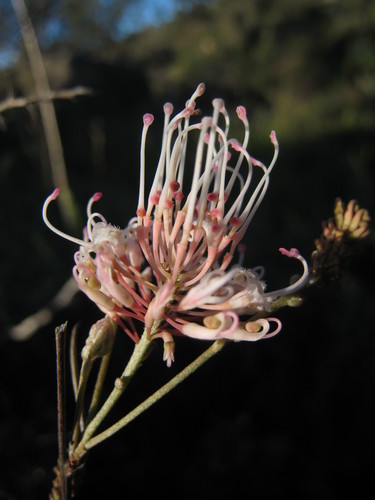
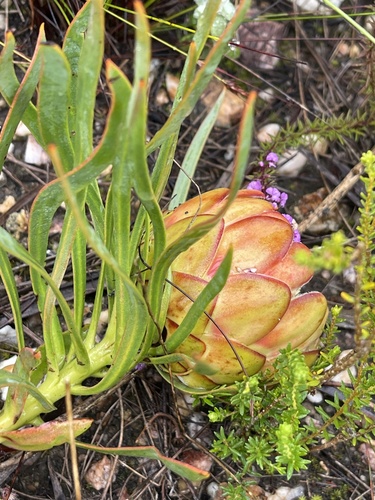
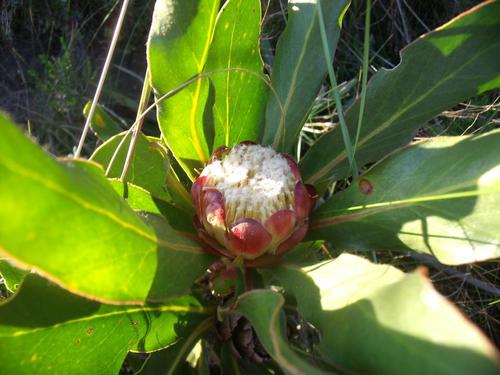
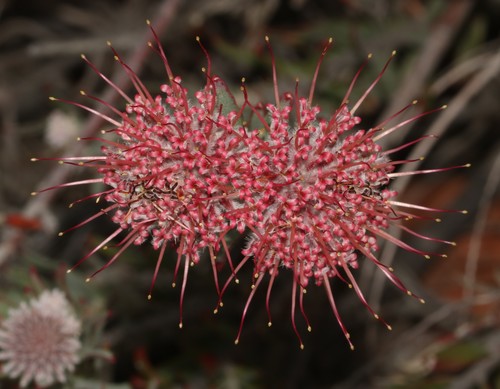
Leucospermum calligerum is a shrub that reaches ½–2 m (1½–6 ft) in height, and up to 3 m (9.8 ft) in circumference, with a single main stem at its base. It produces wand-shaped stems that branch at wide angles, starting out either horizontal or growing upright. Stems are generally 23–30 cm (0.75–0.98 ft) long and 3–5 mm (0.12–0.20 in) thick at flowering time, and are covered in tiny soft crinkled hairs, plus longer soft straight or curved hairs. This species has simple, tough, leathery leaves that are grey to olive in color, shaped oval to long-oval. Leaves grow alternately along branches, overlapping or more scattered, with a thickened blunt or pointed tip, and sometimes bear two or three very small teeth. The leaf base is either rounded or narrowing towards the stem; leaves measure 1.8–3.2 cm (0.71–1.26 in) long and 4¼–8½ mm (0.17–0.33 in) wide. Leaves often have visible veins, are greyish from a covering of tiny soft crinkled hairs, sometimes have longer soft straight or curved hairs, and are typically felty when young. Hemisphere-shaped flower heads are nearly stalkless or sit on a stalk up to 3 cm (1.2 in) long. They mostly grow in clusters of two to six, rarely singly, near the ends of branches. Older flower head clusters can be overgrown by new young growth, making them appear positioned along the branch instead of at the tip. Each flower head is 2–3½ cm (0.8–1.4 in) in diameter, and is subtended by an initially cup-shaped involucre made up of narrow, heavily overlapping, woolly, rubbery (or cartilaginous) bracts. Bracts measure 5 mm–7 mm × 2 mm–3 mm (0.197 in–0.276 in × 0.079 in–0.118 in), with a pointed tip that has tufts of long fine hairs. Individual unopened flower buds are straight, pale green, 1½–1¾ cm (0.60–0.67 in) long tubes that are brown opposite the anthers, covered in long straight silky hairs. When the flower opens, a ½ cm (0.2 in) long tube remains, while the four lobes curl backward. Lobes are initially cream-colored and later develop a pink flush. The style is 21–25 mm (0.83-0.98 in) long, narrower toward the tip, and slightly curved toward the center of the flower head. It is pale at the base and carmine pink toward the tip. The pollen-presenter, a thickened structure at the tip of the style comparable to the head of a pin, is conical to oval in shape, yellow in color, and around 1 mm (0.04 in) long. It initially holds bright yellow pollen. The stigma is a transverse groove at the very tip of the pollen-presenter. At the base of the ovary, there are four awl-shaped hypogynous scales around 2 mm (0.08 in) long. The fruit is oval, blunt-tipped, almost hairless, and ¾ cm (0.3 in) high. The flowers of Leucospermum calligerum have a sweet scent. The subtribe Proteinae, which the genus Leucospermum belongs to, consistently has a basic chromosome number of twelve, with 2n=24. L. calligerum is one of the more widely distributed Leucospermum species, occurring from the Gifberg near Vanrhynsdorp and the Lokenberg south of Nieuwoudtville in the north, to Albertinia in the southeast. It grows on hot, dry, well-drained sandy flats and steep rocky slopes, most often on weathered Table Mountain sandstone, but also on conglomerates of Cape Granite and Malmesbury Shale. It grows between 15–1,200 m (49–3,937 ft) elevation. This species is restricted to locations that receive between 25–50 cm (9.8–19.7 in) of rain during winter, with an average annual rainfall of less than 75 cm (30 in). Common name arid pincushion, this plant is visited by birds including the orange-breasted sunbird Anthobaphes violacea and the Cape sugarbird Promerops cafer, as well as insects including beetles, bees, and flies. Birds are considered the most effective pollinators for non-creeping Leucospermum species. Seeds ripen around two months after flowering. Each seed has an attached fleshy elaiosome (ant bread) that attracts ants. Ants collect the seeds, carry them underground to their nests and eat the ant bread, a seed dispersal strategy called myrmecochory. Plants rarely survive the natural fires that occur in fynbos every decade or two. After fire, rain carries specific fire-created chemicals underground that trigger the seeds to germinate, allowing the species to resprout anew from seed.