About Leucospermum bolusii Gand.
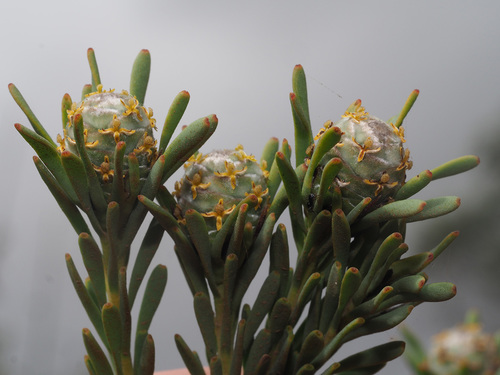
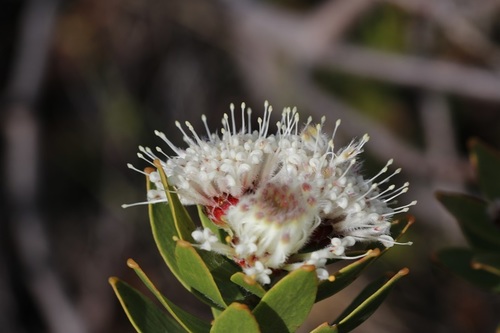
Leucospermum bolusii Gand. is an evergreen shrublet that grows upright to spreading, forming a rounded shape up to 1½ m (5 ft) in diameter from a single main stem. Its upright, slender flowering branches are 3–5 mm (0.12–0.20 in) in diameter and covered in felty hairs. The stalkless leaves may hold some powdery hair when young, are slightly overlapping, more or less oriented upright, and oval to elliptic in shape. They measure 2½–4½ cm (1.0–1.8 in) long and ¾–1½ cm (0.3–0.6 in) wide, ending in a pointy to blunt bony tip. Leaf margins are usually entire, but sometimes bear two or three bony teeth. Globe-shaped flower heads with flattened tops, around 2 cm (0.8 in) in diameter, are each set on a woolly stalk about 1 cm (0.4 in) long and 2 mm (0.08 in) in diameter. These flower heads occur in groups of up to eight near the tip of branches. The flat common base of the flowers within a single head is 5–7 mm (0.20–0.28 in) wide, and is subtended by soft, papery, red to carmine, oval bracts with pointy tips that are 4–5 mm (0.16–0.20 in) long and 2 mm (0.08 in) wide. These bracts become hairless but retain a regular row of short hairs along their margins, and are arranged in about three overlapping whorls that form a cup-shaped involucre. Bracts subtending each individual flower are lance-shaped with a pointy tip, about 7 mm (0.28 in) long and 1½ mm (0.06 in) wide. They are covered in dense felty or woolly hairs, and are gully-shaped at mid-length on their inner side. The 4-merous perianth is straight in bud, about 12 mm (0.48 in) long, initially creamy white in color that later becomes very pale pink. The lower part of the perianth where lobes are fused, called the tube, is about 5 mm (0.20 in) long, hairless at its base, powdery higher up, and slightly squared across. The middle part of the perianth where all four lobes become free when the flower opens, called the claws, are covered in felty hairs and strongly curled back at the base. The upper part of the lobes, called the limbs, are broadly lance-shaped, reddish in color, about 1 mm (0.04 in) long, and covered by long soft silky hairs on the outside. The style is 1½–2 cm (0.6–0.8 in) long, straight, and tapering near the tip. The slightly thickened tip, called the pollen presenter, is pale yellowish green, cone- to egg-shaped, and ¾–1 mm (0.03–0.04 in) long. Four opaque, thread-shaped scales about 1 mm long subtend the ovary. The flowers of L. bolusii have a strong sweet scent. This species has a very restricted range, found in the hills between Gordon's Bay and Kogel Bay (halfway to Pringle Bay), in a strip no more than about 400 m (¼ mi) from the sea, and below about 150 m (500 ft) elevation. It grows in fairly dense stands on steep, rocky, westward facing slopes consisting of Table Mountain Sandstone, and gives the landscape a pink hue, particularly adjacent to Gordon's Bay. Within its range, annual precipitation measures 750–1150 mm (30–45 in). The flowers of the Gordon's Bay pincushion are pollinated by insects such as flies, butterflies, bees and wasps. After fruits fall to the ground, they are collected by native ants and carried to their nests. Ants eat the elaiosome, a pale, fleshy, tasty part of the fruit that also contains a pheromone particularly attractive to ants, while the seed remains underground underground. The seed is protected here against consumption by rodents and birds. After an above ground fire kills the existing vegetation, subsequent rain triggers the seeds to germinate and revive the local population.