About Leucos aula (Bonaparte, 1841)
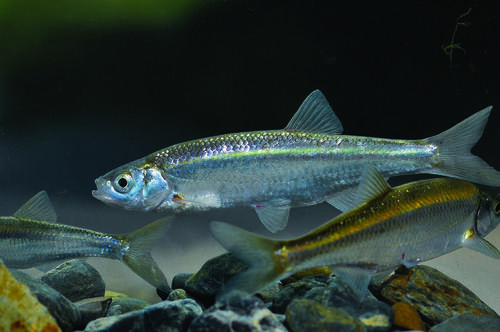
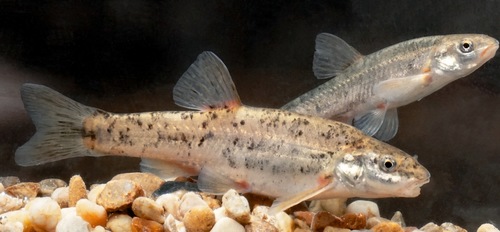
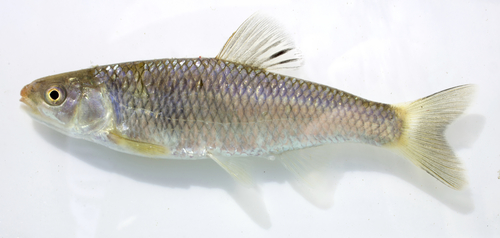
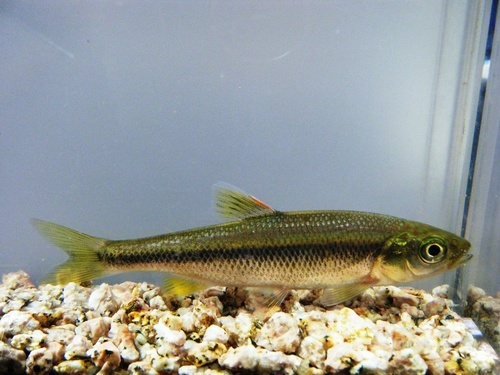
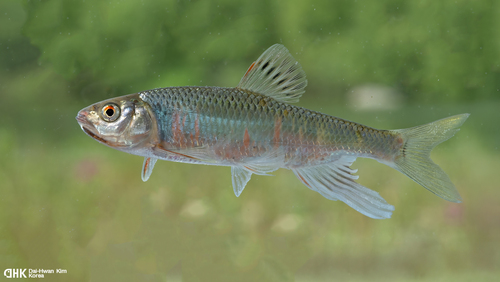
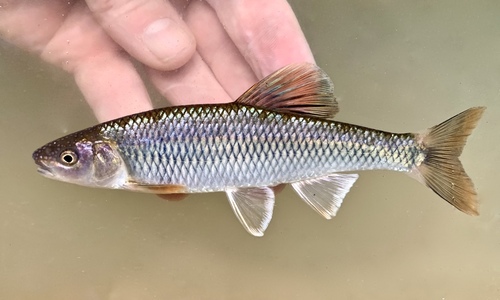
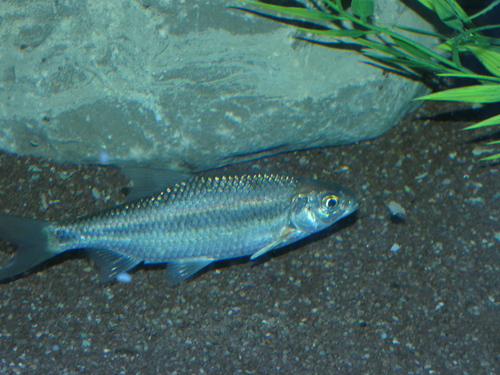
Leucos aula (Bonaparte, 1841) has 12 soft rays supporting each of its dorsal and anal fins. It can be told apart from all other species in the genus Leucos by the presence of a band along the lateral line and a shorter head. Within Italy, this species is further distinguishable by its common count of 9+1⁄2 branched rays in both the dorsal and anal fins. It has between 36 and 42 scales along the lateral line, most often 38 or 39. Its mouth is subterminal, its pelvic, pectoral, and anal fins are greyish, and its eye is red when alive. A distinct dark brown midlateral stripe runs from the eye to the base of the tail. This species, commonly called the North Italian roach, reaches a maximum total length of 26 cm (10 in).
Leucos aula is native to rivers that drain into the northern Adriatic Sea, ranging from the Esino River in Italy’s Marche region to the Raša River in Croatia’s Istria County. A small number of isolated populations occur further south in Croatia’s Zadar County: these include populations at Lake Veliko on the island of Pag, and at least two short coastal streams in Ravni Kotari near the city of Zadar. It may also occur in the Lake Vrana basin. In Italy, this species (also referred to as the North Albania roach) has been introduced to areas south of its natural range, into rivers that drain into the Ligurian Sea and Tyrrhenian Sea, where it is classified as invasive. It has also become naturalized in at least one reservoir in Sardinia.
The North Italian roach inhabits slow-moving stretches of river, lakes, and ponds, most commonly in lowland areas. It can also be found in perialpine lakes within the Po River drainage in Italy and Switzerland. This species is often associated with submerged vegetation, and regularly colonizes reservoirs and drainage channels.