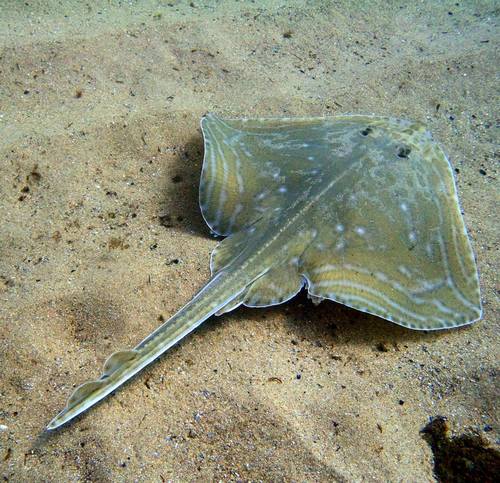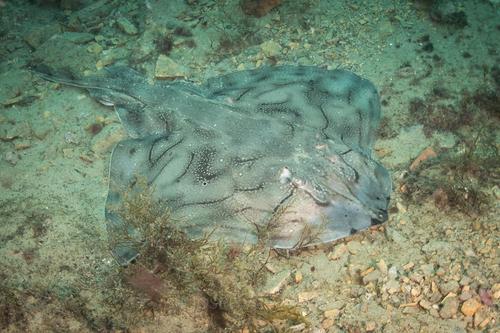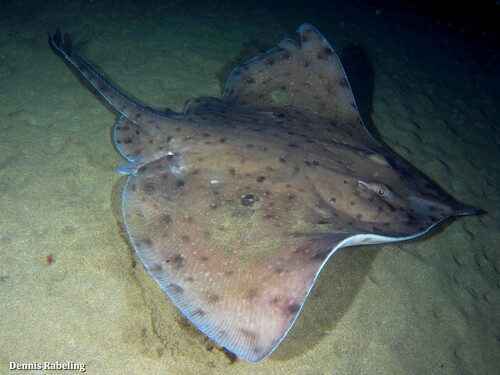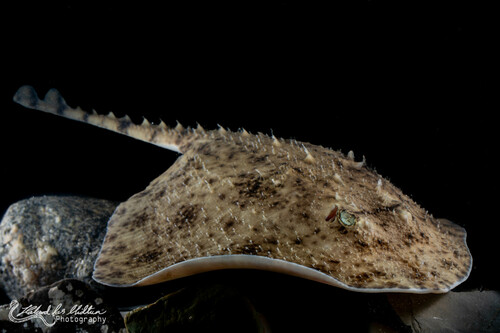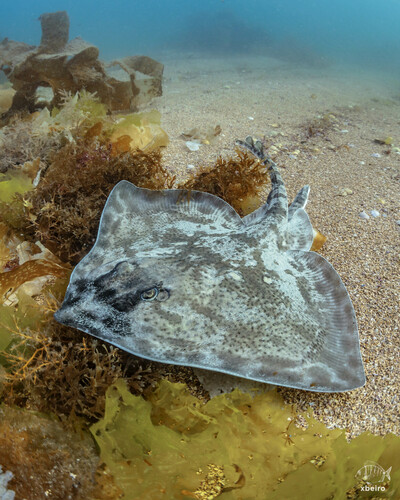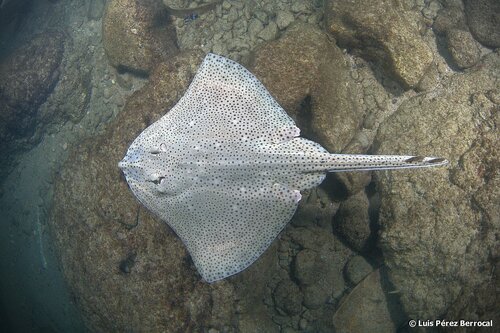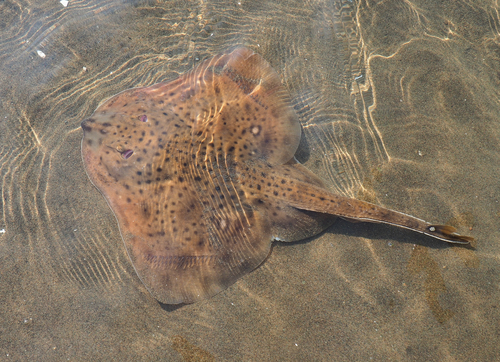
About Leucoraja ocellata (Mitchill, 1815)
Leucoraja ocellata (Mitchill, 1815), commonly called the winter skate, can reach a maximum total length of 109 cm (43 inches). Maturity is reached around 12 years of age, with timing that varies by sex and location. Winter skates use their fins for swimming, and their tail stays stiff during most movement. Their dorsal body is light brown with small dark spots, and most of their body disc and tail are covered in small spines. L. ocellata typically has 1 to 4 eye-like markings called ocelli on the upper surface of its disc; each ocellus has a dark brown center and a pale outer edge. Its upper jaw holds 72 rows of teeth. This species closely resembles the little skate, Leucoraja erinacea. On average, 50% of males reach maturity at a total length of 730 mm when they are 11 years old, while 50% of females reach maturity at a total length of 760 mm between 11 and 12 years of age. This is a relatively late-maturing, long-lived species, which makes it vulnerable to overexploitation. The lower surface of the winter skate is usually white with irregular light brown blotches. Individuals from the Gulf of Saint Lawrence population mature at a much younger age and smaller size, with the estimated age for 50% maturity in this group around five years. Winter skates are found in the northwest Atlantic Ocean, ranging from north of the Gulf of St. Lawrence, Canada, to Cape Hatteras, North Carolina. They prefer habitats with sand and gravel, and are primarily found at depths between 111 m and 371 m (364 to 1217 feet), in water temperatures ranging from -1.2 °C to -15 °C (30 °F to 5 °F). Local populations of winter skate are not evenly distributed. For example, L. ocellata is facing extirpation in the Southern Gulf of St. Lawrence, which has led to far fewer of its egg cases being found on local beaches; the species' range in this area declined by 99% between the 1980s and 2015. Winter skates are oviparous, meaning they lay eggs. Their reproductive strategy is defined by slow growth and late maturity. They lay one egg at a time inside a protective egg capsule, sometimes called a mermaid's purse. On average, L. ocellata lays 50 eggs per year, compared to 30 eggs per year for the little skate, which means winter skates have higher fecundity than little skates. The winter skate's egg capsule functions similarly to the shell of a bird or reptile egg. Gestation time for winter skates in the Gulf of Saint Lawrence is 6 to 9 months, matching the gestation time of the related little skate. Winter skate development follows the general ontological stages shown in Figure 1, which are commonly conserved across skate species. However, L. ocellata has taxon-specific differences in the timing of reshaping of the mandibular arch region, development of branchial filaments, median fins, and denticles, as well as the order of branchial cleft formation. These differences make universal chondrichthyan developmental staging less applicable to this species. Winter skates eat a diverse range of prey throughout their lives. Small juvenile winter skates feed mostly on small shrimp such as seven-spine bay shrimp (Crangon septemspinosa), shrimp-like crustaceans called gammarid amphipods, and sand lance (Ammodytes). Adult L. ocellata feed mostly on fish, including rainbow smelt (Osmerus mordax) and winter flounder (Pseudopleuronectes americanus). Adults also consume Atlantic rock crab (Cancer irroratus), Atlantic razor clams (Siliquia costata), Atlantic herring (Clupea harengus), three-spined stickleback (Gasterosteus aculeatus), and various flatfish in the order Pleuronectiformes. Analysis of stomach fullness across sampling times found that stomachs are fullest at 0600 hours and 2000 hours, indicating winter skates are most likely to feed at night. Dips and peaks in stomach fullness throughout the day are shown in Figure 4.