About Leucoraja erinacea (Mitchill, 1825)
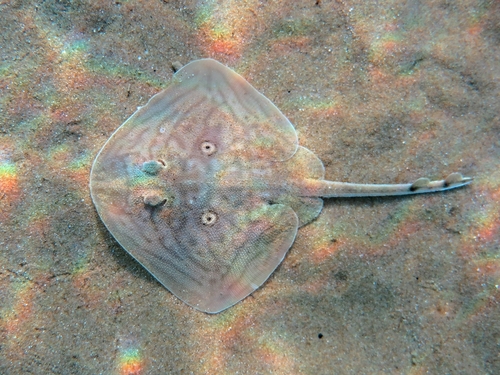
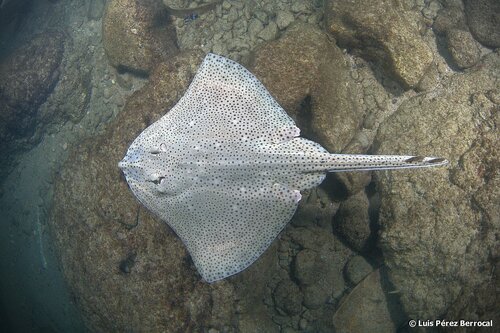
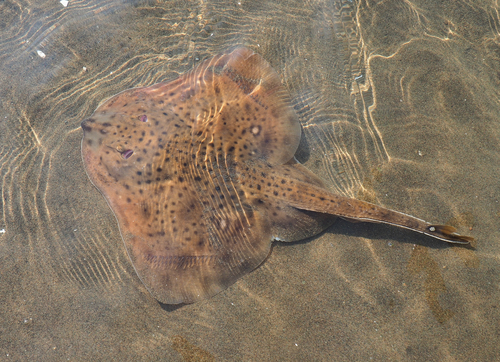
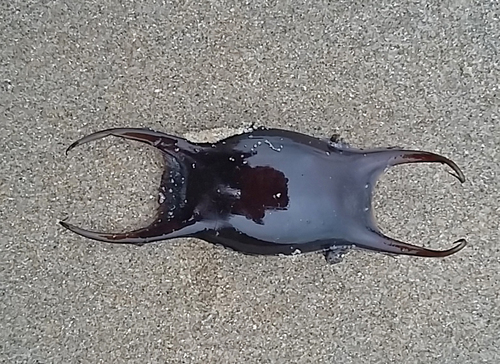
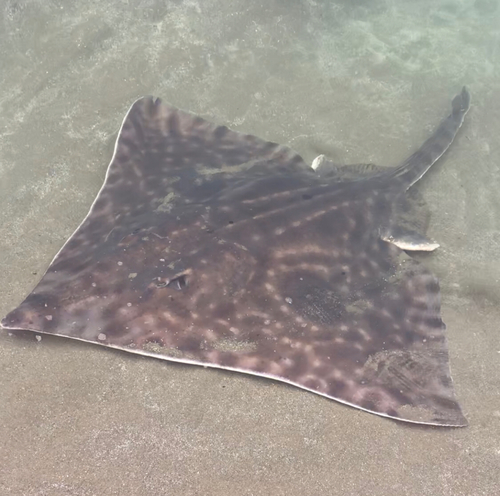
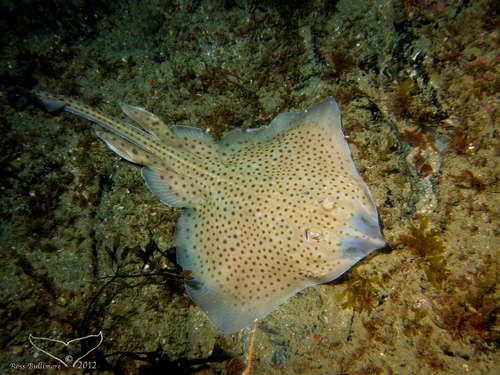
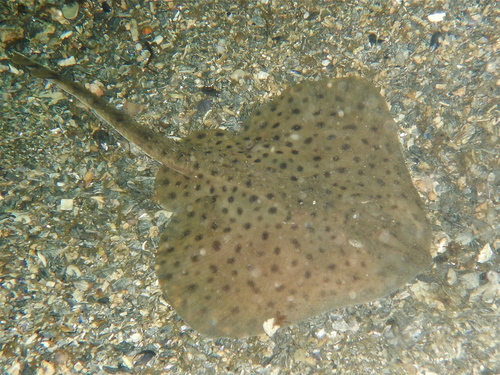
The little skate, with the scientific name Leucoraja erinacea (Mitchill, 1825), has a rounded pectoral fin disk that is 1.2 times as wide as it is long, and a blunt snout with a central tip. Its jaws hold 38–66 series of round teeth set on plates, which are adapted for grinding food. The pelvic fins are split into two parts, with the forward lobe modified into a leg-like structure. For juvenile little skates, the tail is longer than the disk, while for adults the tail is shorter than the disk. Two small, closely spaced dorsal fins sit near the tip of the tail. Adult little skates have small dermal denticles and usually lack midline thorns, but they have strong spines on the dorsal surfaces of the head, shoulders, and tail. Males generally have fewer spines than females. The upper side of the little skate ranges in color from grayish to uniform or variable shades of brown, lightening toward the edges of the disk, while the underside is white or gray. Most individuals have small, round, dark spots on their back. The tail has irregular dusky blotches, or has a dark gray ventral surface. The little skate can be confused with unspotted individuals of the winter skate (Leucoraja ocellata), which shares a similar body shape. This species typically reaches 41–51 cm (16–20 in) in length, and may grow as long as 54 cm (21 in). Little skates grow to a larger maximum size in the northern part of their range. This skate is native to the western Atlantic Ocean, ranging from Nova Scotia, Canada, to Cape Hatteras, North Carolina, USA. It is most abundant in the northern Mid-Atlantic Bight and Georges Bank. Little skates prefer sandy or gravelly habitats from the shore down to a depth of 90 meters (300 ft), though individuals have been caught as deep as 329 m (1,079 ft). They can tolerate temperatures between 1.2–21 °C (34.2–69.8 °F) and salinities of 27–33.8 ppt, with an optimum range of 29–33 ppt. Little skates do not undertake long migrations, but in the inshore parts of their range, individuals move into shallower water during summer and deeper water during fall and winter. At the southern extent of their range, many individuals also move north and south as temperatures change. Little skates are more active at night, and spend most of the day buried in sediment, usually near specific landscape features like depressions dug by other animals. They use a distinctive mode of locomotion that the first scientists to document it called "punting" to move across the sea floor. The forward lobes of the pelvic fins are modified into leg-like structures called crura (singular crus), which have three flexible joints and modified skeletal and muscular elements. The little skate pushes off the seabed with both crura, then glides a short distance on its pectoral fins (wings) while repositioning the crura for the next push. The crura also act as pivots when the skate needs to turn. Research suggests this locomotion is similar to that of land vertebrates, which pushes back the estimated origin of the underlying genes by 20 million years. It has been hypothesized that using pelvic fins in this way helps with hunting by reducing water turbulence that could alert prey or distort the ray's electroreception. The tail of the little skate holds an electric organ that intermittently produces a weak electric field, called the electric organ discharge (EOD). The EOD lasts 70 ms and has a head-negative monophasic waveform. This electric organ is thought to be used for communication, and may help potential mates find one another. Young and adult little skates are preyed on by sharks, other skates, teleost fishes including cod, goosefish, sea ravens, longhorn sculpins, bluefish, and summer flounder, gray seals, and rock crabs (Cancer irroratus). Their egg-cases are preyed on by the sea urchin Strongylocentrotus droebachiensis and the whelk Buccinum undatum. Known parasites of the little skate include the protozoans Caliperia brevipes, Haemogregarina delagei, and Trypanosoma rajae, the myxosporeans Chloromyxum leydigi and Leptotheca agilis, the nematode Pseudanisakis tricupola, and the copepods Eudactylina corrugata and Lernaeopodina longimana. Little skates are oviparous. Mating occurs frequently throughout the year, and pregnant females can be found year-round. Even so, eggs are most common between October and December and between April and May, and least common between August and September and between February and March. On average, little skates spawn twice a year, in spring and fall, producing 10–35 eggs annually. Females deposit their egg capsules in pairs on sandy bottoms, in water no deeper than 27 m (89 ft). When first laid, the egg cases are amber-colored, but they become greenish-brown and leathery over time. Each roughly rectangular case holds a single fertilized egg, and measures 44–63 mm (1.7–2.5 in) long and 30–45 mm (1.2–1.8 in) wide. Hollow horns at each corner have sticky tendrils to anchor the egg case to the substrate; the anterior horns are half as long as the case and curved inward, while the posterior horns are as long as the case and nearly straight. Eggs raised in captivity hatch in 5–6 months, while wild eggs may take up to 12 months to hatch, depending on water temperature. While developing inside the case, embryos have a whip-like extension on the tail that is believed to be used to circulate water around the embryo. Newborn little skates measure 93–102 mm (3.7–4.0 in) long, and are fully formed miniatures of adult little skates. After hatching, the empty egg capsules often wash ashore, and are commonly called "mermaid's purses." For the first three years of life, little skates grow about 10 cm (3.9 in) per year; growth then slows to 5 cm (2.0 in) per year between the third and fourth years. By adolescence, males are larger than females, and this size difference continues into adulthood. Males reach sexual maturity at 32–43 cm (13–17 in) long, while females reach maturity at 36–45 cm (14–18 in) long. Very few little skates over 5 years old have been recorded, which suggests the species has a high mortality rate. An unusual little skate specimen found near Fishers Island, New York, had a developed testis, vas deferens, and functional clasper on its left side, and an adolescent ovary, shell gland, oviduct, and underdeveloped clasper on its right. This example of hermaphroditism (a bilateral gynandromorph) is one of very few recorded for elasmobranch fishes.