About Leucopogon virgatus (Labill.) R.Br.
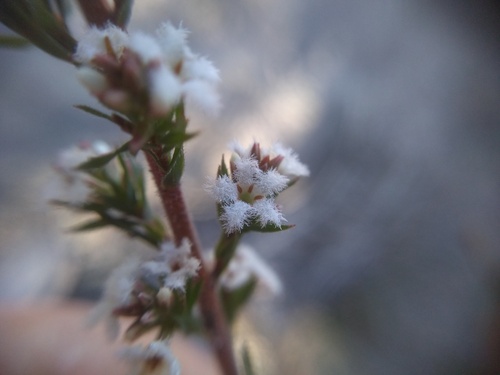
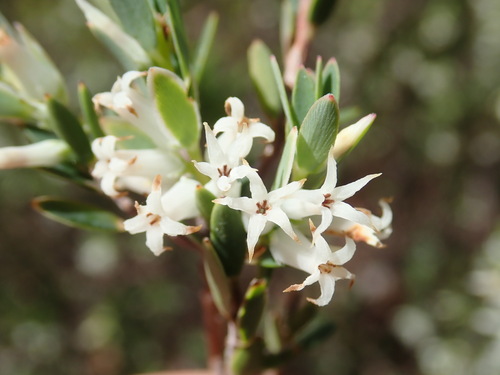
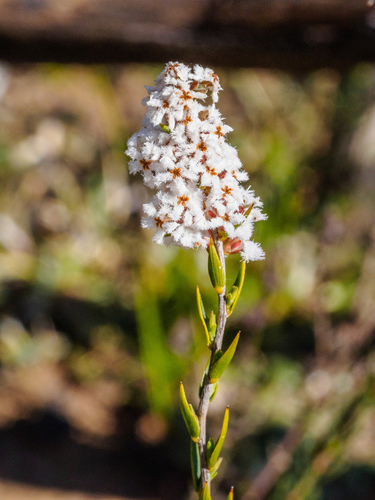
Leucopogon virgatus (Labill.) R.Br. is an erect to low-lying shrub, usually growing 35 to 60 cm (14 to 24 in) tall. It has softly hairy, reddish brown branchlets. Its leaves are held more or less erect, and range in shape from linear to narrowly lance-shaped or egg-shaped. Each leaf is 2–25 mm (0.079–0.984 in) long, 0.9–5.0 mm (0.035–0.197 in) wide, and grows on a petiole up to 1 mm (0.039 in) long. Both sides of the leaves are glabrous, the same shade of green, and the lower surface bears three more or less parallel veins. Flowers are erect and arranged in groups of four to seven, held in 5–10 mm (0.20–0.39 in) long spikes at the ends of branchlets and in upper leaf axils. The egg-shaped bracteoles are about 1 mm (0.039 in) long. The sepals are egg-shaped, 1.7–3.0 mm (0.067–0.118 in) long. The petals are white, 3.0–3.5 mm (0.12–0.14 in) long, joined at the base to form a tube. The petal lobes are about the same length as the tube and are densely bearded on the inside. Flowering occurs from July to December, and the fruit is an oblong drupe about 2.3 mm (0.091 in) long. Leucopogon virgatus var. virgatus grows in heath, woodland and forest on the coast and ranges, up to an altitude of 600 m (2,000 ft), in south-eastern Queensland, New South Wales, the Australian Capital Territory, and is widespread across Victoria, south-eastern South Australia and Tasmania. Variety brevifolius grows in heath or heathy woodland in western Victoria and south-eastern South Australia, and in forest and woodland in the Northern Midlands of Tasmania.