About Leucophaeus fuliginosus (Gould, 1841)
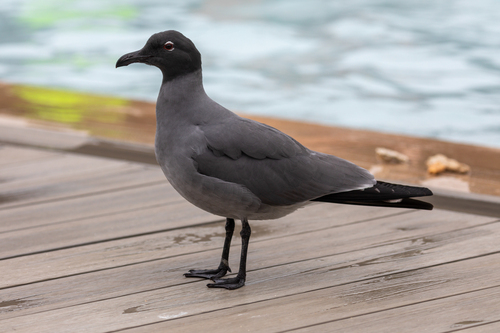
The lava gull, scientifically named Leucophaeus fuliginosus (Gould, 1841), is a distinct gull species. Adults measure 51 to 55 cm (20–22 in) in length and weigh an average of 380 g (13 oz). Adult plumage features a sooty brown to black head that does not change with the season, unlike the heads of other dark-hooded gull species. The wings are dark gray with a contrasting white line along the leading edge, which is thought to function in courtship or territorial displays and camouflage. The lava gull's dark gray body contrasts with its paler gray belly. The uppertail is white, while the lower portion of the tail is gray. Both the bill and legs are black, and the inside of the mouth is bright scarlet. The species has white upper and lower eyebrows, with red eyelids. Immature lava gulls are generally uniformly dark brown. The entire global population of lava gulls is restricted to the Galapagos Islands, where individuals are found predominantly on the islands of Santa Cruz, Isabela, San Cristobal, and Genovesa. Previously, the total population was estimated at 300–400 breeding pairs; this estimate was revised downward to 300–600 total individuals in 2015. The lava gull is currently considered the rarest gull species in the world.