About Leucophaeus atricilla (Linnaeus, 1758)
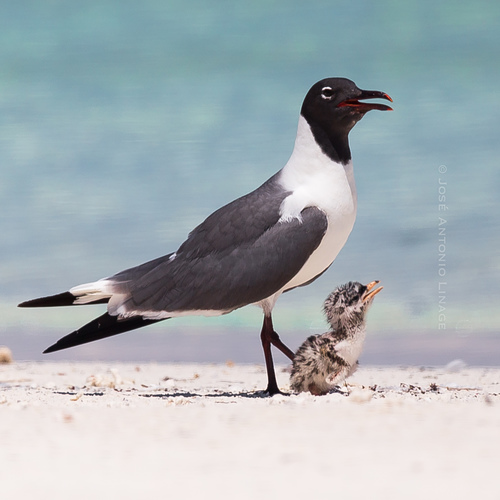
This species measures 36–41 cm (14–16 in) in length, has a 98–110 cm (39–43 in) wingspan, and weighs between 203–371 grams (7.2–13.1 oz). In summer, adult individuals have a white body, paired with dark grey back and wings, and a solid black head. Their wings are much darker grey than all other similar-sized gulls, with the exception of the smaller Franklin's gull. Unlike Franklin's gull, this species has black wing tips that lack a white crescent marking. It has a long, red beak. Adults lose most of their black head hood during the winter. Laughing gulls require three years to reach full adult plumage. Immature laughing gulls are always darker than most similar-sized gulls, again excepting Franklin's gull. First-year laughing gulls are greyer on their underparts, have paler heads than first-year Franklin's gulls, and have a fully black tail. Second-year birds can be identified by their specific wing pattern, which features more extensive black coloring on the primary coverts, and they sometimes still retain some black on the tail. The species' common English name comes from its raucous kee-agh call, which sounds like a high-pitched "ha... ha... ha..." laugh. This gull breeds along the Atlantic coast of North America, throughout the Caribbean, and in northern South America. The northernmost breeding populations migrate further south for winter, and the species is a rare vagrant visitor to western Europe.