About Leuconotopicus borealis (Vieillot, 1809)
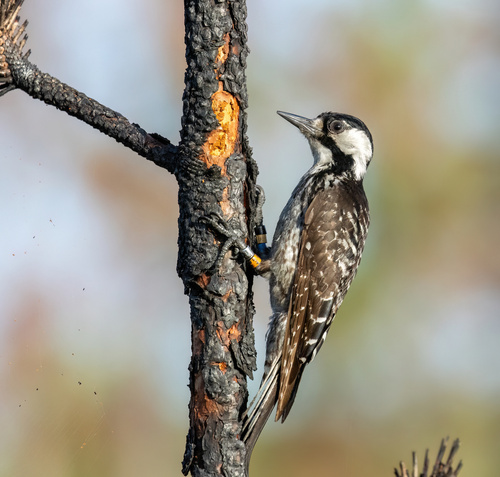
Leuconotopicus borealis, commonly known as the red-cockaded woodpecker, is a small to mid-sized woodpecker species that falls in size between the downy woodpecker and hairy woodpecker, the two most widespread woodpeckers in North America. This species has a total length of 18–23 cm (7.1–9.1 in), a wingspan of 34–41 cm (13–16 in), and a body weight of 40–56 g (1.4–2.0 oz). Its standard physical measurements are as follows: wing chord 9.5–12.6 cm (3.7–5.0 in), tail 7–8.2 cm (2.8–3.2 in), bill 1.9–2.3 cm (0.75–0.91 in), and tarsus 1.8–2.2 cm (0.71–0.87 in). The back of this woodpecker is marked with horizontal black and white bars. Its most distinctive feature is a black cap and nape that surround large white patches on the cheeks. The male has a small red streak called a cockade on each side of its black cap, which gives the species its common name; this marking is rarely visible except during the breeding season and when the bird is defending its territory. The red-cockaded woodpecker is classified as Near Threatened by the IUCN and listed as Threatened by the United States Fish and Wildlife Service.
Historically, the range of the red-cockaded woodpecker covered the southeastern United States, stretching from Florida north to New Jersey and Maryland, west to eastern Texas and Oklahoma, and inland to Missouri, Kentucky, and Tennessee. Today, it is estimated that there are around 5,000 groups, or 12,500 individual red-cockaded woodpeckers, ranging from Florida to Virginia and west to southeastern Oklahoma and eastern Texas. This current population represents only about one percent of the species' original population, which once numbered over 1 million individuals. The species has been extirpated (locally extinct) in Kentucky, Maryland, Missouri, New Jersey, and Tennessee. Red-cockaded woodpeckers inhabit fire-dependent pine savannas. They most commonly prefer longleaf pines (Pinus palustris), though other southern pine species are also suitable. Unlike other woodpeckers, which create cavities in dead, soft, rotten wood, the red-cockaded woodpecker is the only woodpecker that exclusively excavates its nesting cavities in living pine trees. The older pines favored by this species often have a fungal infection called red heart rot, which softens the inner heartwood at the center of the trunk. Excavating a single cavity generally takes the woodpecker between 1 and 3 years. A group of cavity trees used by the species is called a cluster, which may hold 1 to 20 or more cavity trees across an area of 3 to 60 acres (12,000 to 240,000 m²), with an average cluster covering about 10 acres (40,000 m²). A social group of red-cockaded woodpeckers typically defends a territory of 125 to 200 acres (500,000 to 800,000 m²), though observed territories range from a minimum of around 60 acres (240,000 m²) to a maximum of over 600 acres (2.40 km²). Territory size depends on both habitat suitability and population density. In areas with high population densities, red-cockaded woodpeckers spend more time on territorial defense, which often takes time away from foraging and reproduction, leading to smaller clutch sizes and fewer fledglings produced.
The red-cockaded woodpecker is a keystone species in southern pine forest ecosystems. At least 27 vertebrate species use the cavities the woodpeckers create after they are abandoned, including small birds like eastern bluebirds, tufted titmice, and great crested flycatchers, mammals like the evening bat, and herpetofauna like broad-headed skinks and gray treefrogs. Many invertebrate species such as wasps, bees, moths, and ants also use these cavities secondarily. Pileated woodpeckers (Dryocopus pileatus) often enlarge existing cavities made by red-cockaded woodpeckers, which makes the tree unsuitable for red-cockaded woodpeckers to inhabit, but creates habitat for larger bird species such as eastern screech owls, wood ducks, and American kestrels. Smaller animals, including red-bellied woodpeckers, red-headed woodpeckers, and southern flying squirrels, may compete directly with red-cockaded woodpeckers for access to unenlarged nest cavities.