About Leucodonta bicoloria (Denis & Schiffermüller), 1775
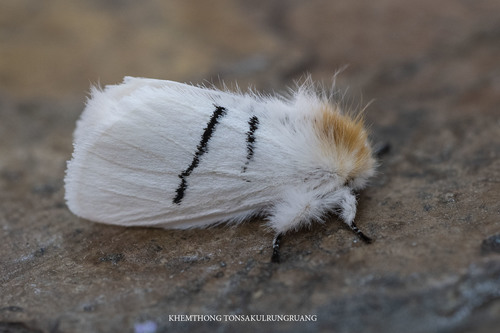
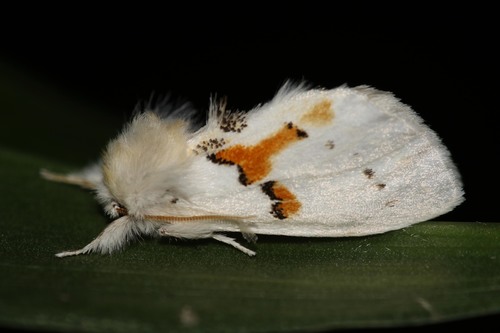
Scientific name: Leucodonta bicoloria (Denis & Schiffermüller), 1775. According to Seitz's description, this moth is pure white. Its forewing bears a transverse row of bright ochreous spots edged in black on their proximal side. This row starts at the anterior margin of the cell and becomes much wider toward the hind margin. In the distal half of the forewing, there is a transverse row of blackish spots; only the last of these spots is prominent, and it sits in a broad yellow patch before the hind margin. The moth's collar may be white or yellow. This species is found in mountainous areas of Central and Eastern Europe, generally occurring sporadically, and it is rare in many locations. Its range extends north to the Baltic provinces and Finland, and east to the Ural and the Carpathians. It also occurs in the Amur and Ussuri districts, and Japan. Two light forms of the species are recognized across Eastern Asia and Russia. The first is albida Bdv., in which the forewing is almost entirely without markings; this form also occurs in Northern Europe as far north as Finland. The second is unicolora Mén., which is entirely white except for a small number of black scales on the forewing. This form is found in the Baltic provinces, and it is the predominant form in Eastern Asia. The egg of this species is slightly convex, glossy, and white, yellowish, or greenish. The larva is glossy and yellowish green, with several darker yellow longitudinal lines along its back, and a similar stripe below its intensely black stigmata. Its legs and anal claspers are ringed with black. Larvae are active from July to August, and feed on birch. The pupa is black-brown, and develops inside a white cocoon on the ground, between fallen leaves.