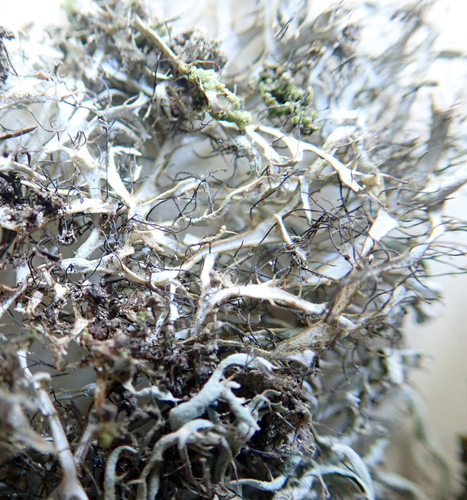
About Leucodermia leucomelos (L.) Kalb
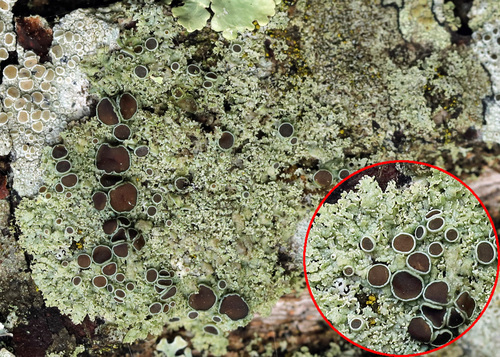
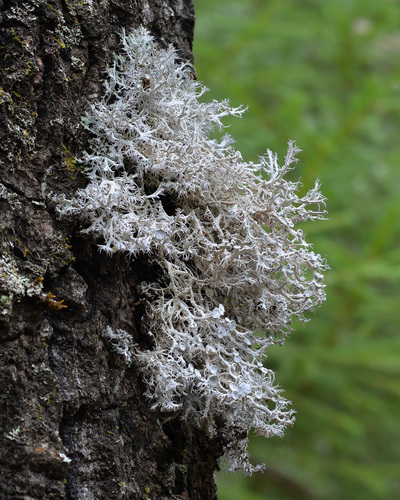
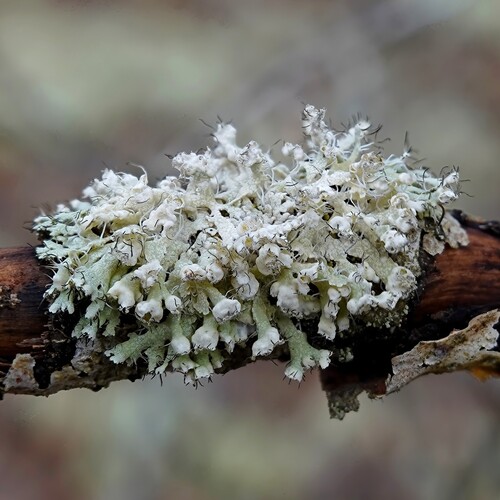
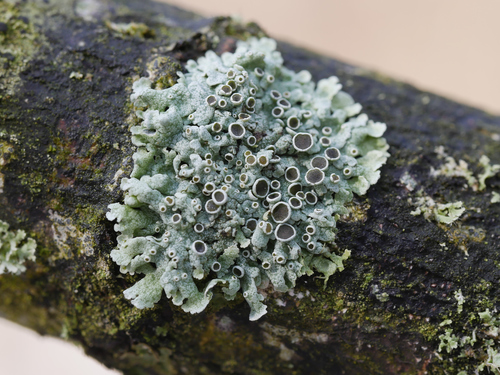
Leucodermia leucomelos (L.) Kalb has a foliose to somewhat fruticose thallus that grows loosely attached or partly free from its substrate in the characteristic leucomelos growth form. It forms loose circular rosettes or tangled mats measuring 5–15 cm (2.0–5.9 in) wide. The thallus is made up of elongated, narrow lobes 0.5–4 mm (0.020–0.157 in) wide that branch dichotomously, and bear long, typically branched dark cilia along their margins. The upper thallus surface is whitish to cream-coloured, smooth, and somewhat shiny. The lower surface is usually white, sometimes pale to pinkish brown, and rarely purple; it lacks a cortex except at the margins, and also lacks rhizines, and appears arachnoid (cobwebby), woolly, or powdery. Soredia develop to varying degrees, and typically form on the distal portion of the lower thallus surface, which becomes exposed as the lobes curl upwards. This species rarely produces apothecia; when apothecia are present, they are lecanorine (with a thalline margin), subterminal, and somewhat stalked. They measure about 2–5 mm (0.1–0.2 in) across, have margins ranging from crenulate to lobulate, and bear small triangular lobules up to 3 mm long. The apothecial disc is dark brown to black and may be pruinose. The asci are club-shaped (clavate), eight-spored, have a Lecanora-type structure, and show characteristic iodine reactions. The ascospores are brown, ellipsoid, and 1-septate, measuring 30–50 x 15–23 μm, and follow Polyblastidium-type development with sporoblastidia. Pycnidia are rare and immersed, and produce hyaline bacilliform conidia measuring 4–5 x 1 μm. The photobiont partner of Leucodermia leucomelos is a chlorococcoid green alga. In North America, the range of Leucodermia leucomelos extends from Belleville, Ontario in the north, south to Mexico. It occurs in scattered locations from the central and southern Appalachian Mountains down to Florida, and along the North American west coast from Vancouver Island through Mexico and into Central America. Despite this broad distribution, it is not considered a particularly common lichen in North America. In Ontario, Canada, it was recorded for the first time in over 150 years in 2019. In the Pacific Northwest of North America, Leucodermia leucomelos is a rare coastal lichen. It grows in forested dunes, marine terraces, and headlands up to elevations of 250 m (820 ft), and occurs within 4 km (2.5 mi) of the coast, specifically in the marine fog belt that stretches from Point Reyes near San Francisco to the Oregon-Washington border. This lichen is common in exposed microsites in both young and mature forests, predominantly within Sitka spruce forest ecosystems. It can also be found in forest types dominated by lodgepole pine, grand fir, and western hemlock, often with a dense shrub understory. Leucodermia leucomelos grows mostly on twigs and branches of Picea sitchensis (Sitka spruce) and Pinus contorta (lodgepole pine), but also colonizes Abies grandis (grand fir), Tsuga heterophylla (western hemlock), Alnus rubra (red alder), Baccharis pilularis (coyotebrush), Cytisus scoparius (scotchbroom), Ceanothus sp., Cupressus macrocarpa (Monterey cypress), Arctostaphylos uva-ursi, and Garrya elliptica (silktassel). Other lichen species commonly found growing alongside it are Ramalina farinacea, R. roeslerii, Tuckermanopsis chlorophylla, Hypogymnia heterophylla, and Parmotrema chinense. In the Azores, where the species is abundant, it grows from sunny coastal rocks and walls up to mossy trees in moist cloud forest, at elevations up to 1,000 m (3,300 ft). In Afromontane forests of South Africa, L. leucomelos occurs at altitudes between 1500 and 1600 metres, where the climate has warm, wet summers and dry, cold winters that reach freezing temperatures. In these habitats, the species shows a particular affinity for Leucosidea sericea, though it can colonize various other tree species. Leucodermia leucomelos is widespread across eastern Africa except for desert regions, and has been recorded growing at altitudes up to 3,500 m (11,500 ft). In this region, recorded habitats include mossy rocks, earth banks, and the trunks, branches, and twigs of trees and shrubs, with a preference for shaded sites. In the Canary Islands, L. leucomelos is a characteristic species of undisturbed laurel forests, and is present in over half of studied laurel forest plots. It appears sensitive to environmental conditions, and prefers ancient, well-preserved forest environments with high humidity and low disturbance. A 2019 metagenomics study found that L. leucomelos was one of only nine lichen species (out of 339 studied) that hosted cystobasidiomycete yeasts in its thallus. While these basidiomycete yeasts were previously thought to be ubiquitous across all lichens, L. leucomelos was among just 2.7% of the studied species that showed evidence of hosting these organisms. The yeast sequences detected in L. leucomelos had coverage comparable to that of the primary lichen fungus itself, which suggests the yeasts are genuine symbionts rather than chance contaminants. Known lichenicolous (lichen-dwelling) fungi that parasitise L. leucomelos include Arthonia leucomelodis, Abrothallus heterodermiicola, Leptosphaeria leucomelaria, and Stigmidium heterodermiae. Zyzygomyces leucodermiae and Tremella leucodermiae are both southern hemisphere basidiomycete lichenicolous fungi that use L. leucomelos as a host.