About Leucocoprinus fragilissimus (Ravenel ex Berk. & M.A.Curtis) Pat.
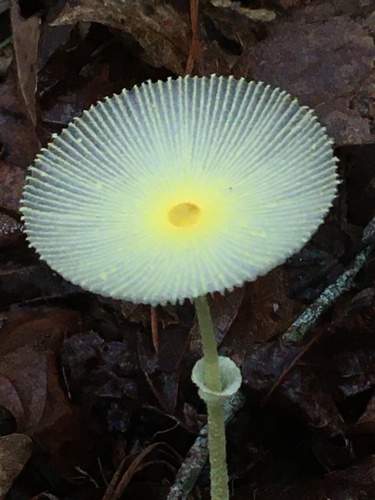
Leucocoprinus fragilissimus is a small dapperling mushroom with very thin, extremely fragile yellow flesh. Its cap is 2–4.5 cm wide, starting convex before expanding to nearly flat with a small central disc or umbo. The cap surface is pale greenish yellow with a darker centre, and fades to almost white with a yellowish centre as it ages. Its gills are free, widely spaced, and pale yellow. The stem measures 4–9 cm long and 1–2 mm thick, running equally down to a small, very slightly bulbous base. It is extremely fragile, with a smooth pale yellow surface that also fades to nearly white. A fragile yellow stem ring sits in the middle of the stem, and it may disappear over time. This species produces a white spore print. Its spores are ellipsoid with a large pore, dextrinoid, and measure 9–12 x 7–8 μm. It has an indistinct smell. Like all Leucocoprinus species, L. fragilissimus is a saprotroph that feeds on heavily decayed plant matter such as humus or compost. It grows individually or sparsely in wooded areas. It can be found in southern North America, South America, southern Europe, Africa, southern and eastern Asia, Australia, and New Zealand. In 1867, Belgian botanist Jean Kickx documented Agaricus flammula growing in tanbark in the greenhouses of the Ghent Botanical garden during August and September. In 1871, Berkeley and Broome described Lepiota licmophorus from Peradeniya, Sri Lanka, which was then known as Ceylon, where the species was found growing on the ground. Many of their observations took place in this area, so it is possible the observations were made in or near the Royal Botanical Gardens, Peradeniya, which was founded in 1843. They noted that the fungus was also found in their hothouses, and concluded it was likely introduced to these spaces alongside exotic plants. In 1874, Gillet described Lepiota flammula from France, where the fungi were observed growing in small tufts of 3-4 mushrooms in greenhouses during Summer and Autumn. In 1907, Morgan documented Lepiota fragilissima growing on earth and decayed vegetation on the edges of swamps in South Carolina, where it was found growing both individually and in groups.