About Leucocasia gigantea (Blume) Schott
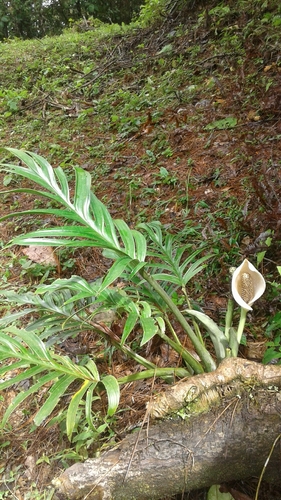
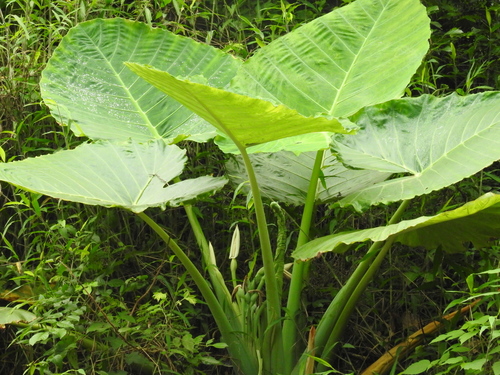
Leucocasia gigantea, also commonly known as giant elephant ear or Indian taro, is a species of flowering plant in the aroid family. It is the only species in the genus Leucocasia. This plant grows to between 1.5 and 3 meters (4 feet 11 inches to 9 feet 10 inches) tall, has a large fibrous corm, and produces a whorl of thick green leaves at the top of the corm.
In cultivation, Leucocasia gigantea is a sister species to the widely cultivated taro, Colocasia esculenta, and also to alocasias including the large Alocasia macrorrhizos. It has been hypothesized that L. gigantea originated from natural hybridization between A. macrorrhizos and C. esculenta. It has different common names across regions: in northern Vietnam it is called dọc mùng, while in some southern Vietnamese provinces it is called môn bạc hà or bạc hà. In Japanese, it is most commonly known as ハス芋 (hasu-imo), meaning "lotus yam"; in Kōchi Prefecture it is called ryukyu, because it occurs in the Ryukyu Kingdom.
Leucocasia gigantea is used as a food plant. Its large starchy root is valued as a root vegetable, known by many general names including taro and arbi in Hindi. In parts of Southeast Asia and Japan, the plant's leaf stalk (its petiole) is also eaten as a vegetable. It is sometimes added as an ingredient to miso soup, chanpurū, and sushi.