About Leucocarbo onslowi (H.O.Forbes, 1893)
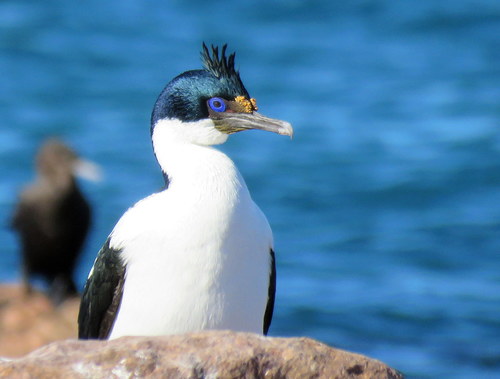
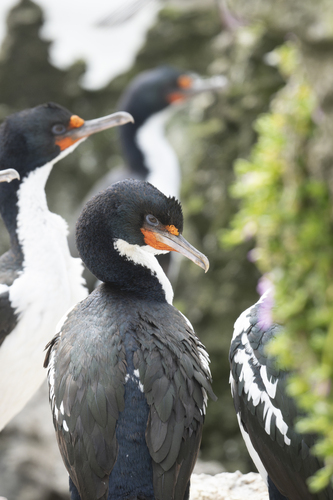
Leucocarbo onslowi, commonly known as the Chatham Islands shag, has the following description. Adult Chatham Islands shags measure 63 cm (25 in) in length and weigh between 1,790–2,400 g (63–85 oz). This is a large pied shag with white feathers on the throat, breast, belly, and patches on the wing scapulars; all other areas are black or black-brown. During the breeding season, the head and hind-neck display a blue metallic sheen, the wings and mantle have a greenish sheen, and all other black areas have a purplish-blue sheen. Adults have a prominent crest on the head, white filoplumes on the neck, a red gular sac, and orange-red caruncles on the face and mouth gape. Despite the common naming of the genus, the iris is brown, and the eye is surrounded by a violet eye-ring. The bill is dark grey with a bright red interior mouth, and the legs and feet are dull pink. Non-breeding individuals are similar in appearance to breeding birds but are duller overall, lack a crest and filoplumes, and have duller colored bare parts: caruncles are yellow, the eye-ring is blue, the mouth is orange, and the bill is light grey. The species is endemic to the Chatham Islands, an archipelago located approximately 700 km (430 mi) east of New Zealand. Within the Chatham Islands, this is an inshore species that rarely travels more than a few kilometers from shore, and it is most often found in sheltered waters such as bays and inlets. It also forages in the large brackish Te Whanga Lagoon. It breeds in colonies along coastal areas and around Te Whanga Lagoon, nesting on flat ground, slopes, or wide cliff ledges. Currently, there are thirteen known colonies of this species, located on main Chatham Island as well as Pitt Island, Star Keys, Rabbit Island, and North East Reef. All colonies are situated close to the high-tide mark, and a single colony can hold as many as 300 nests. The species roosts on rocks near shore or out at sea, and may use separate roosting sites for day and night. It is non-migratory and has never been recorded outside of the Chatham Islands, though it does feed and roost on other islands within the Chathams group away from its breeding colonies, such as Mangere.