About Leucocarbo bougainvilliorum (Lesson, 1837)
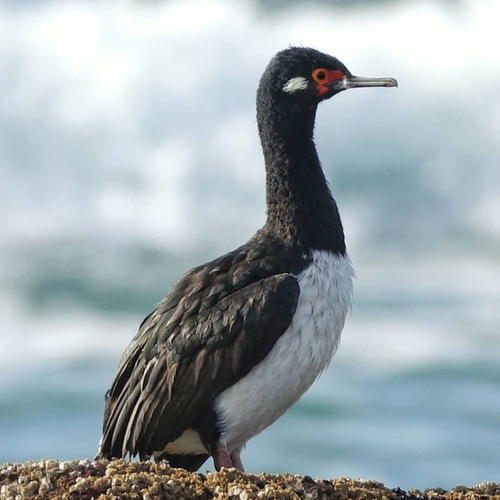
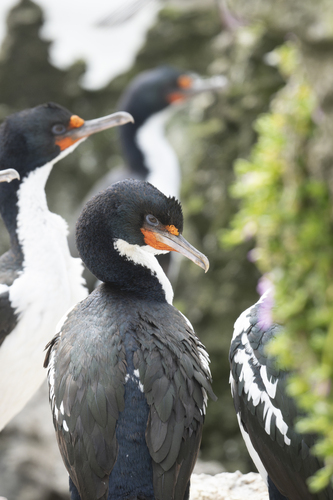
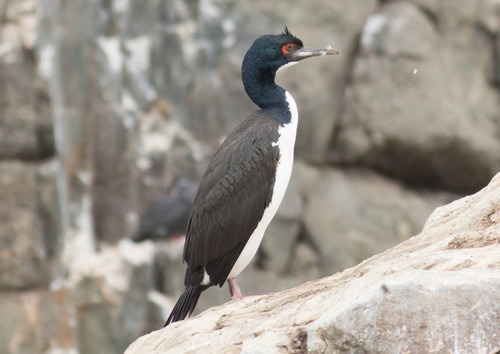
The guanay cormorant, scientifically named Leucocarbo bougainvilliorum (Lesson, 1837), has plumage similar to the rock shag Leucocarbo magellanicus, but it is larger. It measures 71 to 78 cm from the tip of its bill to the end of its tail, and it has more extensive white coloration on its underparts. Its bill is grayish with some red at the base. Its face is red with a green eye-ring, and it has orange-pink feet. The head, neck, back, and outer parts of its thighs are black, while its throat patch, breast, and belly are white. During breeding plumage, it has a small number of white feathers on the sides of its head and neck. For its ecology, breeding can occur throughout the year, with a peak in November and December. It builds its nest out of guano on flat surfaces on offshore islands or remote headlands. In high-density colonies, there can be up to three nests per square meter. The guanay cormorant lays two or three eggs that measure approximately 63 × 40 mm in size. It feeds mainly on Peruvian anchoveta (Engraulis ringens) and Peruvian silverside (Odontesthes regia), both of which thrive in the cold Humboldt Current. This species is the main producer of guano. Habitat loss, habitat degradation, and over-fishing have caused a steady population decline of around 30% from an estimated population of three million birds in 1984. This species is listed as near threatened by the IUCN. Historically, the bird's droppings were such an important source of fertilizer for Andean peoples that it was protected by Inca rulers, who are said to have made any disturbance of these cormorants punishable by death. Its common name is an adaptation of the South American Spanish term guanae, the plural form of the word that becomes guano in English.