About Leucoagaricus meleagris (Gray) Singer
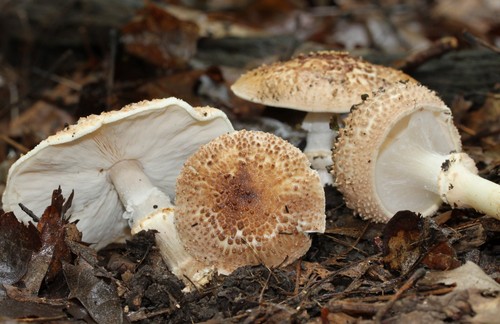
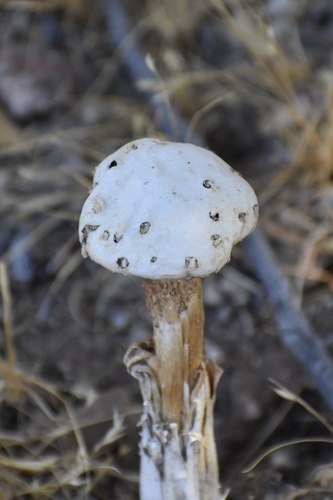
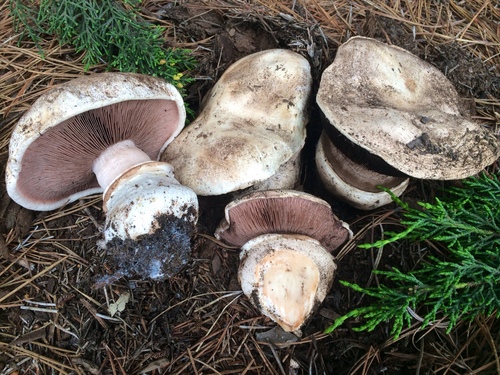
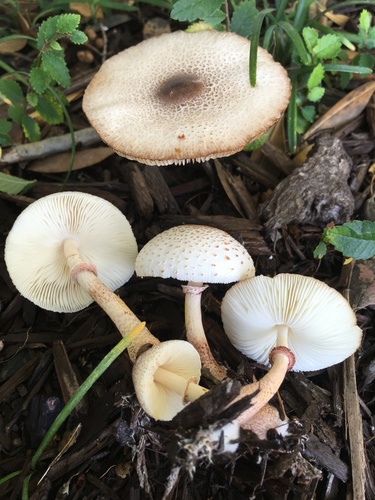
Leucoagaricus meleagris (syn. Macropsalliota meleagris) is a small dapperling mushroom with white cap flesh and brown stem flesh. The cap measures 2–4.5 cm wide: it starts hemispherical, expands to become campanulate (bell-shaped), then becomes plano-convex with a broad umbo. The cap has a white surface background, covered with coarse brownish-red fibrils and scales. The surface discolours to a dirty red with age, when bruised, or even just when handled. The stem is 6–8 cm long, with a clavate shape that tapers upwards from a slightly wider base. The stem surface is white with a fibrillose coating, and also discolours brownish-red when old or bruised. A white, ascending stem ring sits towards the top of the stem (superior); it has reddish scales on its underside and may disappear as the mushroom ages. The gills are free, crowded, and white when young, but they discolour the same way as the rest of the mushroom, becoming yellowish or brownish with age. This species produces a white spore print. Spores are ellipsoid, with a somewhat thick wall and a tiny germ pore; they are smooth, hyaline, and dextrinoid, and measure 8–11 x 6–8 μm. Basidia are four-spored. The taste is slightly farinaceous (floury), and the smell is indistinct. Leucoagaricus meleagris grows in small groups and tufts in autumn. It is reported as widespread but rarely recorded in the United Kingdom. Early taxonomic observations of this species came from greenhouses and bark beds within hothouses, so it may be more common in these warm environments. More recently, it has been documented growing on woodchips in England and Skåne, Sweden, and in greenhouses in Warsaw, Poland. Observations of this species are uncommon across Europe, and the most common locations for reported observations are the East Coast of the United States.