About Leucoagaricus lacrymans (T.K.A.Kumar & Manim.) Z.W.Ge & Zhu L.Yang
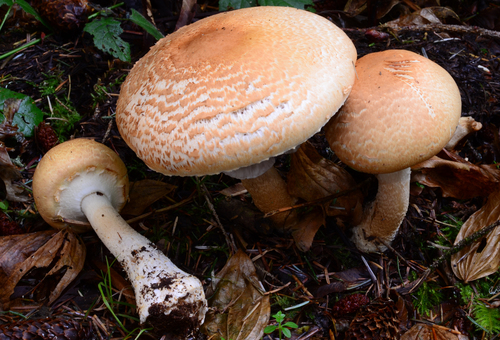
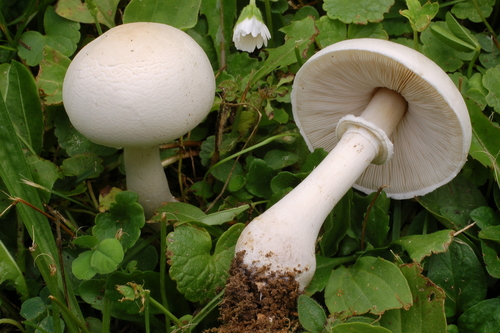
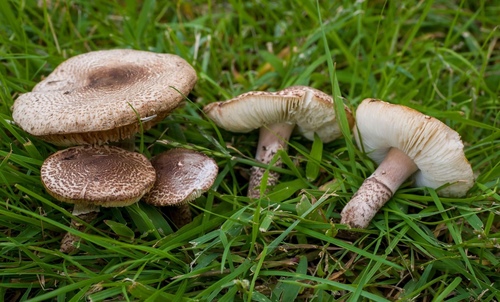
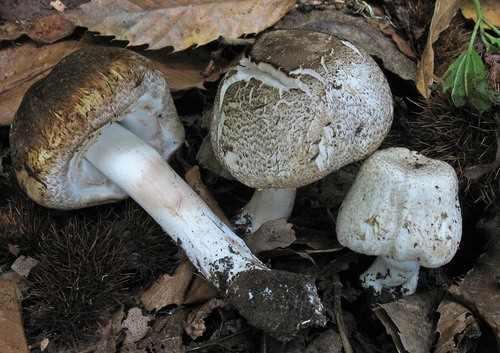
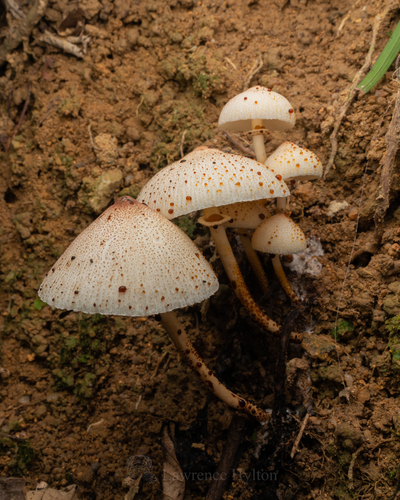
Leucoagaricus lacrymans (T.K.A.Kumar & Manim.) Z.W.Ge & Zhu L.Yang. Description Cap: 3–8.3 cm wide, starting cylindrical with a truncated top, expanding to become campanulate to convex, and finally flattening with age, while often retaining a distinct umbo. The surface is white to creamy in color and covered with minute, flattened (appressed) cinnamon to rusty brown to purplish brown scales. Scales are sparser at the cap margins and denser towards the cap center, where they become more granular (granulose) or slightly velvety (velutinate). Cap margins have striations (sulcate-striate), are entire, start incurved before flattening with age, and become fissile, meaning prone to slight splitting. Cap edges are often covered with yellow to reddish brown guttation, the same moisture droplets found on the stem. The cap flesh is white or whitish, thin at 3mm thick, and discolours to pale orange when cut, turning greyish orange after longer exposure on cut surfaces. Stem: 4–12 cm tall and 5-6mm thick, and stays roughly equal in thickness along almost its entire length, or tapers slightly towards the top. The surface is white or a dirty white color, darkens to brownish with age, is velvety when young (velutinous to villose), and has some flattened fibrils when older (appressed-fibrillose). The stem is often covered with beads of yellow to reddish brown guttation. The interior is hollow, and the base of the stem can have white mycelial cords (rhizomorphs). A membranous stem ring is located towards the top of the stem (superior). Kumar and Manimohan report the ring is white and usually evanescent, disappearing without a trace, while Ge and Yang describe it as brown and persistent. Gills: Free without a collar, moderately crowded and white, aging to yellowish white before discolouring reddish with age or upon drying. They are thin (up to 4mm wide) and may bulge in the middle (ventricose). The gills come in two or three different lengths, their edges are finely fringed, and edges may be tinted greyish on older specimens. Smell: Indistinct. Spore print: White. Spores: When viewed from the side, they are ellipsoidal to broadly ellipsoidal; when viewed front-on, they are ellipsoidal, ovoid or subglobose. They are hyaline and smooth with a distinct germ pore, and are dextrinoid. They measure 5-13 x 4.5-11μm. Basidia: 4 spored. Habitat and distribution Specimens studied by Kumar and Manimohan were collected in Kerala State, India, growing on soil and decaying leaf litter around the base of coconut trees, either solitary or in clusters. Ge and Yang note that the species grows in tropical forests and is known from India and China. As of January 2026, iNaturalist holds observations of this species from India, China and South East Asia, as well as a small number of observations from other locations, suggesting the species may have been introduced to other warm regions.