About Leuciscus leuciscus (Linnaeus, 1758)
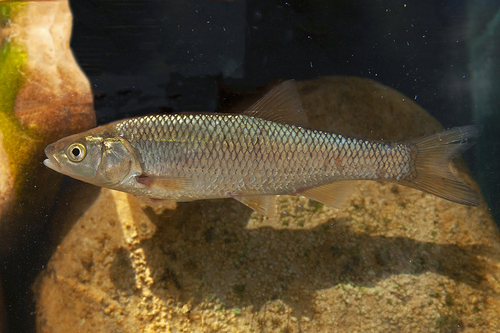
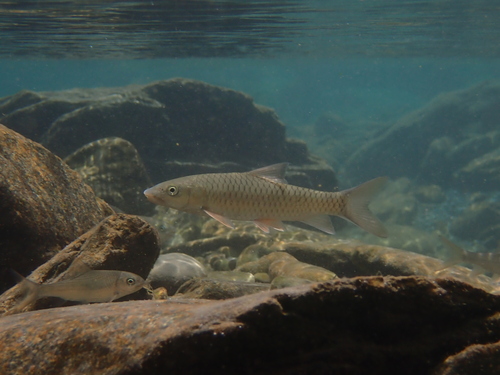
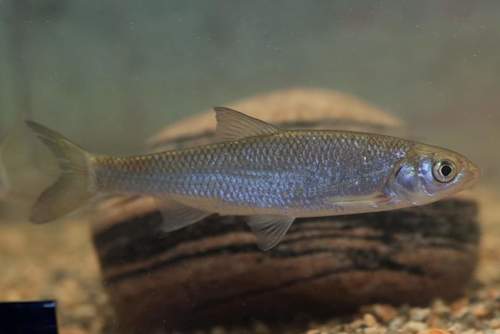
This species has the scientific name Leuciscus leuciscus (Linnaeus, 1758), commonly called the common dace. It differs from other European members of the genus Leuciscus by its inferior mouth, slightly longer upper jaw where the tip of the upper lip sits level with the eye’s center line, and the lack of a prominent snout. It has a yellowish iris and a body covered in large silvery scales, with 49–52 scales along the lateral line. Its anal fin has a concave margin, its caudal fin is forked, the dorsal fin holds 2–3 spines and 7–9 soft rays, and the anal fin holds 3 spines and 8–9 soft rays. The maximum total length this species reaches is 30 centimetres (12 in). The common dace is native to Europe and northern Asia, where it lives in the basins of the North Sea, Baltic Sea, White Sea and Barents Sea. It is also found in the Caspian Sea basin in the Volga and Ural River drainage systems, and in the Black Sea basin it occurs in the Danube and Dnieper. In France, it lives in the Seine River drainage, as well as the Rhone and Arc drainages that flow into the Mediterranean. It has localised distribution in the main Danube river in Romania, in Scandinavia north of 69°N, and in most of central Finland. Populations from Siberia and East Asia are usually classified as Leuciscus baicalensis and Leuciscus dzungaricus instead. This species has been widely introduced to areas of Europe where it did not originally occur. It established populations in Ireland starting in the early 1900s, after being brought there as bait fish to catch larger fish like pike. After its introduction to Ireland, it benefited from parasite release: it lost its original set of parasites when introduced, which may give it a competitive advantage over native fish species. Common dace live in rivers and streams, and can sometimes be found in lakes or in brackish water at river mouths. They are surface-dwelling fish; adult common dace gather into shoals in the lower reaches of rivers and backwaters during winter, though some adults stay upstream on spawning grounds through the entire winter. When spawning occurs in March and April, they migrate upstream to lay their pale yellow eggs on shallow gravel beds in fast-flowing streams. The eggs attach to gravel and stones. Juveniles hide among cavities and roots in bankside vegetation, and move into faster flowing water as they mature. The main food source of common dace is small invertebrates.