About Leuciscus idus (Linnaeus, 1758)
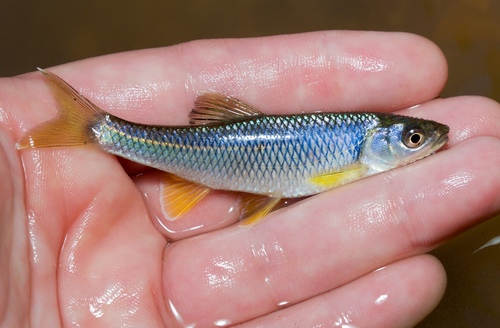
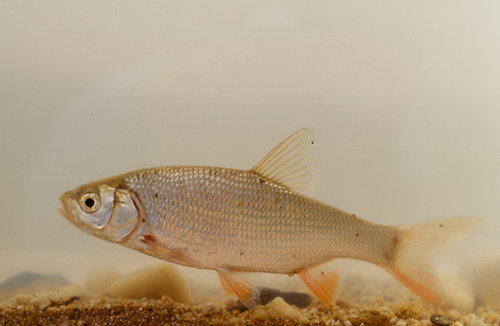
Leuciscus idus, commonly called ide (or orfe when kept ornamentally), is a fairly plump, sturdy fish with a moderately deep body and a thick caudal peduncle. Young ide have dark backs and silvery sides, while older individuals develop a golden sheen along their flanks. At all ages, the ide has yellow eyes and reddish pectoral and anal fins. It has three spines and 8–11 soft rays on its dorsal fin, three spines and 8–11 soft rays on its anal fin, and 19 total rays on its caudal fin, with 47 vertebrae total. It can be distinguished from other European members of the genus Leuciscus by the 56–58 scales along its lateral line, 3.5–5.3 pharyngeal teeth, a terminal mouth, and branching in 8% of dorsal rays and 10% of anal rays. This species typically grows to 25–50 cm in length and weighs 0.5–1.5 kg, and rarely exceeds 2.0 kg. The European rod-caught weight record is 5.5 kg, though there are unconfirmed reports of ide reaching 100 cm in length and 8 kg in weight. The ide is native to Europe and western Asia, ranging from North Sea-draining rivers east through southern Scandinavia and eastern Europe to the Caspian Sea drainage and the River Lena. It was introduced to Great Britain as a popular ornamental fish in 1874, and is now widespread across England and Wales, but only has a localised distribution in Scotland. It was introduced to France, and later introduced as an ornamental fish to the Netherlands from France and Germany. Outside of Europe, the ide was first brought to the United States in 1877, when the United States Fish Commission imported live specimens for intentional stocking in US waters; state agencies later conducted additional stocking, and the species also spread through escapes from commercial and government ponds. It has been reported from nine US states, but its status there remains uncertain: most records are old and document only a few individuals, and the species appears to either have failed to establish self-sustaining populations or been eradicated. In the 1980s, ide were illegally imported as eggs to New Zealand. Fish were released between 1985 and 1986 at between 8 and 13 sites north of Auckland. Ide likely did not persist long at at least seven of these release sites, the outcome at most remaining sites is unknown, and at least one release site’s location is unrecorded. It is likely that ide persist in the wild at at least one site in New Zealand. Ide form schools in clear pools of larger rivers, ponds, and lakes. During winter, they typically move to deeper waters, then return to shallow fresh water to spawn in spring. The species also occurs in the low-salinity Baltic Sea: in Sweden, young ide spend their first year of life in rivers, then migrate downstream to join mature fish in the Baltic Sea during summer, before returning to rivers in autumn, where they stay near the mouths and lower reaches through winter. Ide reach sexual maturity at 3–5 years of age, after growing to a total length between 22 cm and 43 cm; in cooler waters, first breeding may be delayed until the individual is 7 years old. Spawning occurs in shallow water in spring, shortly after ice melts in the colder parts of the ide’s range. Some populations are migratory and ascend rivers and streams to spawn, while others spawn in shallow areas of lakes or sea inlets. Eggs are usually laid among gravel or on emergent vegetation. Spawning typically lasts 3–4 days, during which spawning fish are very active. Each female spawns only once per breeding season, but mates with multiple males during spawning. Males gather at spawning grounds and follow ready-to-spawn females. A female can lay between 15,000 and 250,000 eggs per season; the eggs are pale yellow, roughly 2 mm in diameter, and hatch after 1–2 weeks, producing young fry 8–10 mm long. Incubation period depends on water temperature: at 18.5–22.0 °C, incubation takes about 5 days, and the optimal temperature for embryonic development is between 12–18 °C. Smaller ide prey mainly on larval and adult insects, snails, and other benthic invertebrates; larger individuals are often piscivorous, and commonly eat common roach and common bleak. Young larvae and juvenile ide feed in a wide range of shoreline habitats, and move into deeper water as they grow larger. Smaller ide are sociable and join mixed-species shoals with other cyprinids, while larger adult ide form smaller single-species groups that patrol regular routes. The species prefers clear, warmer water, and is less tolerant of eutrophication than many related cyprinid species. Because ide require running water to spawn, man-made obstructions like dams can negatively impact their populations. When kept as an ornamental fish, this species is usually called orfe. The most common ornamental variety is the golden orfe, which is golden or orange with black spots on its neck near the head. A much rarer blue ornamental variety is known as blue orfe. Because they grow quite large, ide are not considered suitable for indoor aquaria, and are recommended to be kept as a shoal in outdoor ponds. They require better-oxygenated water than koi or goldfish, but can be kept alongside these species. Golden orfe were very popular as ornamental pond fish until koi became widely available in the 1960s. Within its native range, the ide is a popular target for anglers. In eastern Europe, it is considered edible and prized as a food fish, and is commercially netted and sold along the Danube. In more northern parts of its native range, it is not considered a desirable food fish. In the United Kingdom, ide are fished as coarse fish, but tend to be restricted to commercial fisheries or sites where they have been introduced.