About Leuciscus aspius (Linnaeus, 1758)
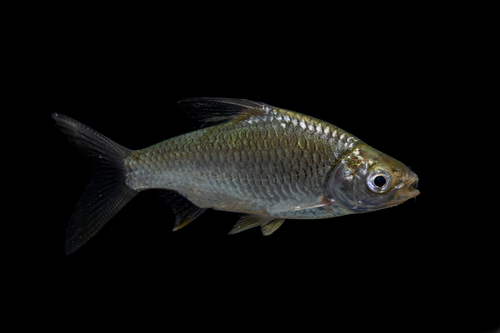
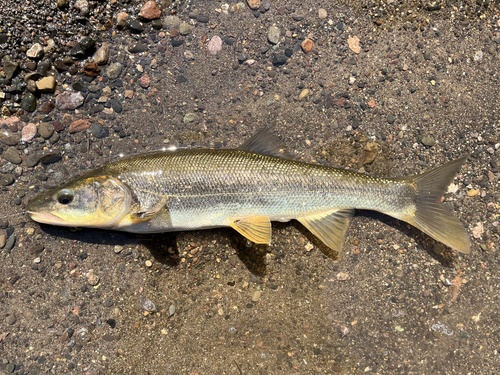
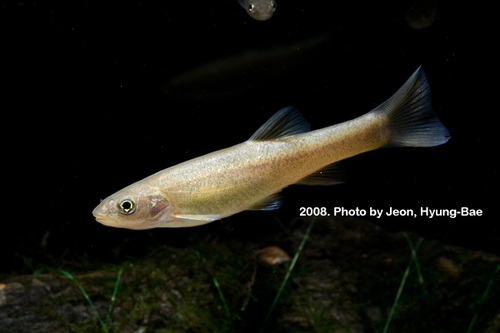
Leuciscus aspius, commonly called the asp, has the following physical characteristics: its dorsal fin is supported by 3 spines and between 7 and 9 soft rays, while its anal fin has 3 spines and between 12 and 15 soft rays. 12 to 14 and a half of the anal fin rays are branched. The lateral line of this fish is made up of 64 to 76 scales. The maxilla extends past the front margin of the eye. A sharp, scale-covered keel runs between the origin of the pelvic fin and the origin of the anal fin. The asp’s body is long and laterally compressed, with a long head and a pointed snout. Its back is green with silver and blue tints, its sides are paler, and its belly is silvery white. Its pectoral, pelvic, and anal fins are colored grey to brown. This species can reach a maximum total length of 120 cm (47 in), with 55 cm (22 in) being a more typical size, and has a maximum published weight of 9 kg (20 lb).
The asp is native to large lowland rivers and lakes in Europe. It is native to river systems that drain into the North Sea, the Baltic Sea, the Black Sea, the Sea of Azov, the Aegean Sea, the Caspian Sea, and the Aral Sea. In North and Baltic Sea drainages, this species occurs from the drainages of the Weser and Elbe eastward, including southern Norway, Sweden, and Finland, extending to the Baltic states. It is found in most river systems that drain into the Black Sea and Sea of Azov, but it is absent from the Crimean Peninsula, coastal drainages in Bulgaria south of the Danube Delta, northern Turkey east of the Yenice River, Georgia, and the Russian coast east of the Kerch Strait. As can be found in all rivers draining into the Caspian Sea, except for rivers along the Caspian’s eastern coast. In the Balkans, it only occurs in the Struma and Maritsa drainage systems in Greece and Bulgaria, and also in Lake Volvi, Greece. Outside of its native range, the asp has been artificially introduced to the Scheldt in France, Belgium, and the Netherlands; the Rhine in Germany; the Seine and Loire rivers in France; the Muga River in Spain; the Po River in Italy; the Northern Dvina River in Russia; and Lake Balkhash in Kazakhstan.