About Leucippus fallax (Bourcier, 1843)
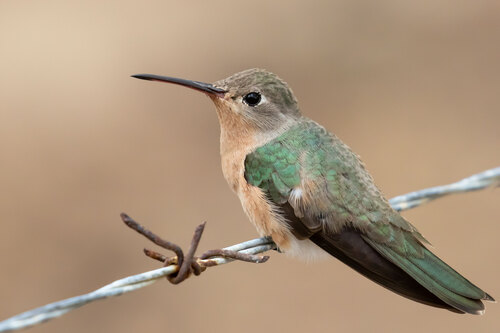
The buffy hummingbird (scientific name Leucippus fallax (Bourcier, 1843)) has males and females that are similar in overall appearance, though females are typically less brightly colored, and individual birds show considerable shade variation. The back and upper parts of the bird are dull green, while the underparts are pale cinnamon-buff, and the belly and undertail coverts are white. Its tail is dull green with a transverse grey bar and has a rounded tip. There is a white spot behind the eye, and the beak is slender and straight: the upper mandible is black, and the lower mandible is pale with a black tip. Adult buffy hummingbirds measure 8.5 to 9 cm (3.3 to 3.5 in) in total length. This hummingbird species is distributed across Colombia, French Guiana, and Venezuela. Its natural habitats include desert shrubland, thorny shrubs in arid regions, and mangrove areas, found at elevations up to 500 metres (1,600 ft). It forages at medium heights and near the ground, and often feeds near the canopy of the forests it inhabits. During courtship, male buffy hummingbirds perform an arc-shaped plummeting fall from the sky, while producing mating calls during the descent. Most nests of this species are found between May and November, so breeding is thought to take place in this window. The nest is cup-shaped, built on a low branch or in the fork of a bush. It is constructed from soft tree cotton fibers, and decorated on the outside with small pieces of bark, lichen, and leaf. Each clutch contains two eggs.