About Leucanthemum vulgare Lam.
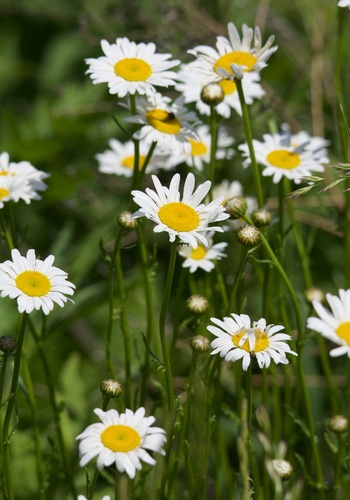
Leucanthemum vulgare Lam., commonly called ox-eye daisy, is a perennial herb that grows up to 80 centimetres (31 inches) tall, with a creeping underground rhizome. The lower sections of its stem are hairy, sometimes densely hairy, while other parts of the lower stem are more or less hairless (glabrous). The largest leaves grow at the base of the plant. These basal leaves are 4–15 cm (1+1⁄2–6 in) long, about 5 cm (2 in) wide, have a leaf stalk (petiole), and can have up to 15 teeth, lobes, or a combination of both along their edges. Leaves get smaller moving upward along the stem. The upper leaves are up to 7.5 cm (3 in) long, have no petiole, and are deeply toothed. Each plant produces up to three typical daisy-like flower heads (capitula), each 2–7.5 cm (3⁄4–3 in) wide. Every head holds between fifteen and forty white ray florets (often called petals), each 1–2 centimetres (3⁄8–3⁄4 in) long, surrounding a central cluster of yellow disc florets. Below the flower head is an involucre made of hairless green bracts. These bracts are 7–10 millimetres (1⁄4–3⁄8 inch) long and have brownish edges. Flowering occurs from May to October. This species produces seed-like achenes that are 1–3 mm (1⁄16–1⁄8 in) long, with ten ribs along their edges, but do not have a pappus. Ox-eye daisy is similar to several related species. It resembles shasta daisy (Leucanthemum × superbum), which has larger flower heads that are 5–12 cm (2–4+3⁄4 in) wide. It is also similar to stinking chamomile (Anthemis cotula), which has smaller flower heads that are 1.5–3 cm (5⁄8–1+1⁄8 in) wide. Leucanthemum maximum is another similar species, which typically has ray florets 2–3 cm (3⁄4–1+1⁄8 in) long. This species is native to Europe, as well as Turkey and Georgia in Western Asia. It is a common perennial wildflower of grassland, growing in a wide range of plant communities including meadows, fields, under scrub, open-canopy forests, and disturbed areas. It has become widely naturalized across much of the world, including North America, and is classified as an invasive species in more than forty countries. It grows in temperate regions where average annual rainfall exceeds 750 mm (30 in), and is often found on heavy, damp soils. It is frequently a weed in degraded pastures and along roadsides. Leucanthemum vulgare spreads both by seed and by shallow, creeping rhizomes. A single mature plant can produce up to 26,000 seeds, which are spread by animals, vehicles, water, and contaminated agricultural produce. Some of its seeds can remain viable for up to nearly forty years. It is not palatable to cattle, and reduces the amount of usable quality grazing pasture. In native landscapes such as Australia's Kosciuszko National Park, dense infestations can outcompete and exclude native plants, leading to increased soil erosion and loss of soil organic matter. A UK study of meadow flowers ranked this plant top for pollen production per sampled floral unit at the whole capitulum level, recording a pollen volume of 15.9 ± 2 μL per capitulum. The unopened flower buds of Leucanthemum vulgare can be marinated and used in the same way as capers. Maud Grieve's 1931 publication Modern Herbal notes that the dried herb has a bitter, tingling taste, and a faint odour similar to that of valerian. Leucanthemum vulgare is widely cultivated and sold as a perennial flowering ornamental plant for gardens and designed meadow landscapes. It grows well in a wide range of conditions, but prefers sunny or partially sunny locations with average damp soil, similar to many other members of the daisy family. It performs well in raised, mulched garden beds that retain moisture and suppress weeds. As a mesophyte, it requires a roughly continuous supply of water. Gardeners often deadhead faded and old flower heads to encourage further blooming and keep the plant looking neat. Several cultivars exist, such as 'May Queen', which starts blooming in early spring.