About Leucadendron salignum P.J.Bergius
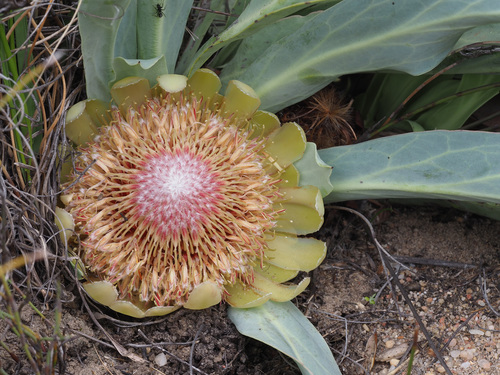
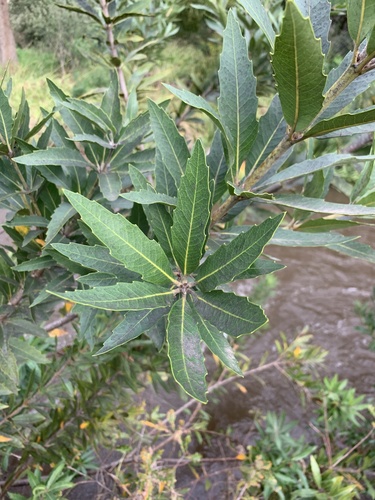
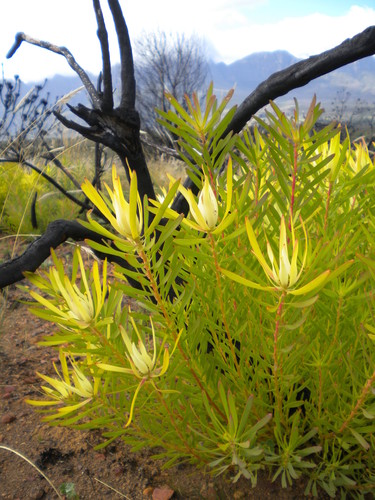
Leucadendron salignum is an evergreen, stiff, upright shrub that grows up to 2 metres (6 ft 7 in) high. Its branches have soft, silky hairs pressed against the surface, and the species has variable leaf sizes and bract colours. Leaves are rigid but relatively thin and leathery, oblong linear or lance-shaped linear, 2+1⁄2–7+1⁄2 cm (0.98–2.95 in) long, 3+1⁄4–6+1⁄2 mm (0.13–0.26 in) wide. Leaves end in a gradual point, or have a pointy tip extended by the midrib, and also have soft, silky hairs pressed against their surface. Like all Leucadendron species, L. salignum has separate male and female flower heads on different individual plants. Male flower heads may be yellow or burgundy red, shaped like a cone or egg, 8–19 cm (3.1–7.5 in) long, and only around 1+1⁄4 cm (0.49 in) across. They are subtended by an involucre of several leaves about 1.9 cm (0.75 in) long, which are often covered in rusty-coloured soft hairs. The bract that subtends each individual male flower is covered with long soft hairs, about 1⁄2 mm (0.020 in) long, oblong in shape, and has an almost pointed tip. In male flowers, the lower part of the 4-merous perianth, which stays merged when the flower opens (called the tube), is 1+1⁄2 mm (0.059 in) long, somewhat compressed, and covered with long soft hairs. The middle part, made of four free segments once the flower opens (called claws), is linear to spade-shaped, about 2 mm (0.079 in) long, and covered with long soft hairs. The upper part consists of four segments (called limbs) that are about 1⁄2 mm (0.020 in) long, elliptic with a somewhat blunt tip, and softly hairy. These limbs are directly connected to the anthers without a filament; the anthers are 1⁄2 mm (0.020 in) long and oblong in shape. The rudimentary style in the male flower is about 3 mm (0.12 in) long, thread-shaped, hairless, with an egg-shaped stigma 1⁄2 mm (0.020 in) long. At the base of the style are four line-shaped scales 1⁄2 mm (0.020 in) long. Young female flower heads are oblong to cylinder-shaped, about 1+1⁄4 cm (0.49 in) long. Their involucral leaves are often ivory coloured and may hide the flower head. Female inflorescences can be either yellow or red. The bract that subtends each individual female flower is softly hairy, transversely oblong, about 2 mm (0.079 in) long and 4 mm (0.16 in) broad. The perianth tube of the female flower is covered with long soft hairs, about 2 mm (0.079 in) long, and compressed. The middle segments of the perianth are about 1 mm (0.039 in) long, line-shaped, and covered with long soft hairs. The four upper segments of the perianth are 1⁄3 mm (0.013 in) long, oblong, and covered with long soft hairs. Staminodes are 1⁄4 mm (0.0098 in) long and line-shaped. The style is hairless, about 3 mm (0.12 in) long, line-shaped but widens toward the cut-off stigma. The ovary is covered with long soft hairs, compressed oblong in shape, and about 1 mm (0.039 in) long. It is subtended by four line-shaped scales 1+1⁄2 mm (0.059 in) long. Mature female heads are egg-shaped, 2+1⁄2–3+1⁄4 cm (0.98–1.28 in) long, and nearly 2+1⁄2 cm (0.98 in) across. The outside of mature bracts is covered in densely matted woolly hairs. Fruits are elliptic, about 4 mm (0.16 in) long, compressed, with a hairless and wrinkled surface. The common sunshine conebush is a widespread and common species found from Nieuwoudtville in the north to the Cape Peninsula in the southwest and Grahamstown in the east. It grows in a wide range of soil types, and occurs from sea level up to about 2,000 metres (6,600 ft) altitude. This species is pollinated by small beetles, including the sap beetle Pria cinerascens and the Adonis ladybird (Hippodamia variegata). Winged seeds stay in the cone on the female plant for many years, until they are released after a fire kills the above-ground plant biomass. Unlike many other Leucadendron, mature L. salignum plants usually do not die after fire, and regrow from their underground rootstock. L. salignum adapts easily to different garden soil types, and is frost tolerant down to −9 °C (16 °F). It has a very long flowering season from May to December, and colourful involucres that surround its flower heads. It also regrows well after deep pruning. This species and several of its hybrids and cultivars are widely used for cut foliage production. Leucadendron ‘Safari Sunset' is a hybrid bred from a red form of L. salignum and L. laureolum. It was first bred in New Zealand in the 1960s, and is now grown commercially in Israel and exported worldwide as a cut flower.