About Lethrinus mahsena (Forsskål, 1775)
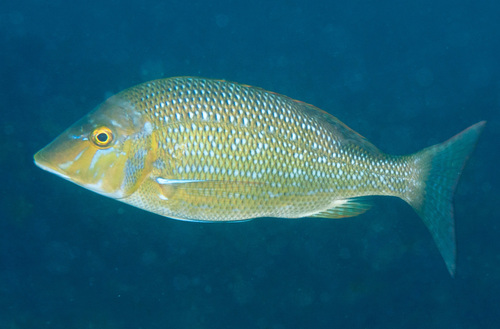
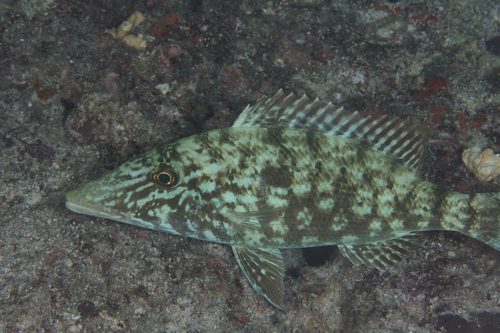
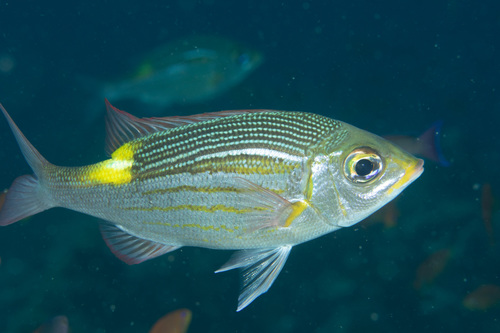
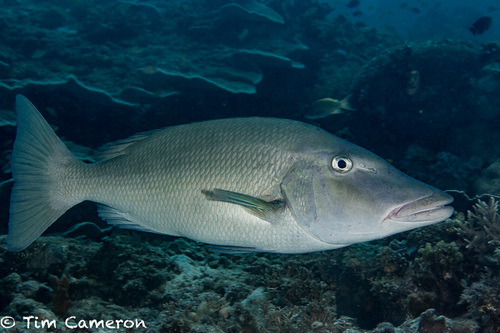
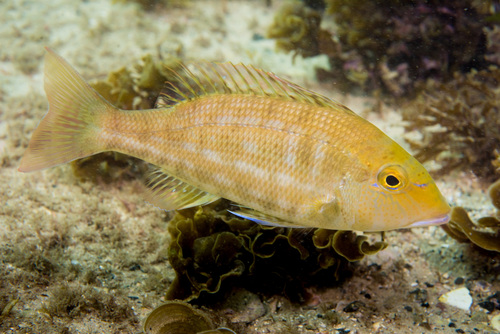
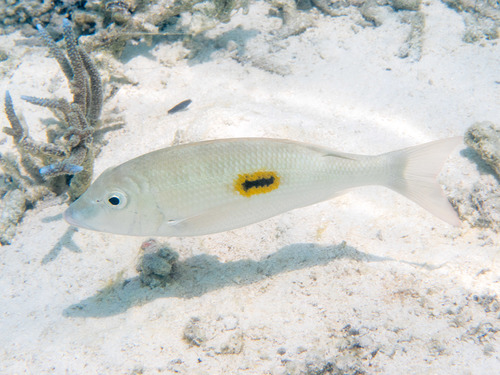
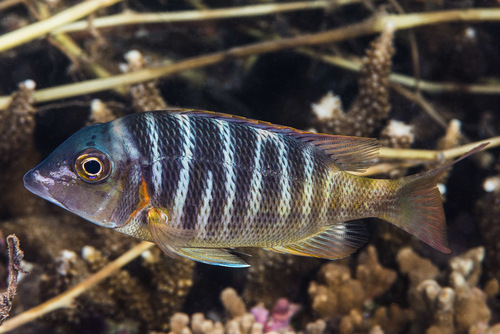
Lethrinus mahsena is a species of fish first described by Forsskål in 1775. Its body ranges in color from yellow to greenish-blue or olive-grey, and becomes paler closer to the belly. Most individuals have 9 to 10 vertical yellow-green or brown bars, plus a horizontal lattice pattern of yellow stripes. The base of each scale may be dark or black, and a red bar marks the base of the pectoral fins. This species reaches a maximum total length of 65 cm, and most commonly encountered individuals measure 35 to 45 cm long. Its head is purplish-grey, and occasionally has a red patch on the nape. It has a moderately short snout and prominent bright red lips. A red line runs from the corner of the mouth toward the tail, and some individuals have a white or yellow line that runs forward from the eye through the nostrils. The profile of the dorsal fin is almost straight to slightly concave. The fins are generally reddish, with the color being most intense toward the tips. Lethrinus mahsena occurs in the Red Sea, East African waters including those around Madagascar, southern Japan, Polynesia, the Seychelles, Cebu in the Philippines, the western Indian Ocean, and Sri Lankan waters. It is a non-migratory, reef-associated fish that lives at depths between 2 and 100 metres. It can be found on coral reefs, adjacent sandy bottoms, and in seagrass areas. This species is a highly valued commercial fish that commands a high market price, and it is also targeted by recreational fishers. When caught in some areas of the Indian Ocean, individuals may have an undesirable "coral" flavor and odor. Most fishing for this species is done with handlines, traps, and trawling.