About Lethrinus lentjan (Lacepède, 1802)
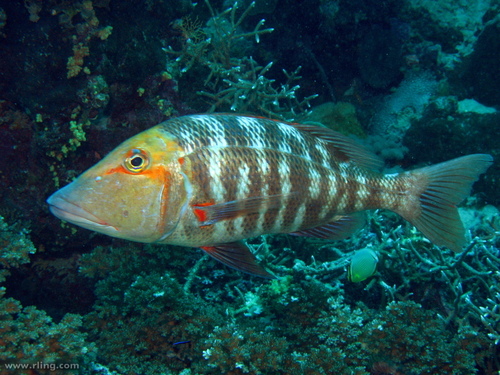
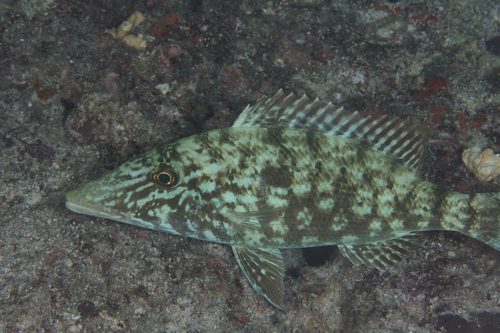
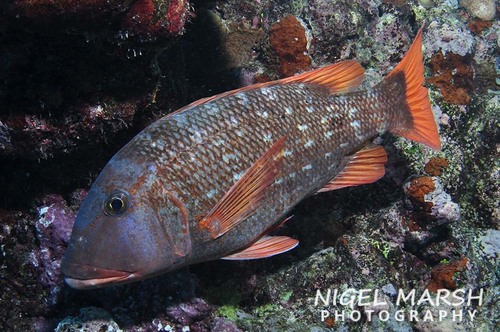
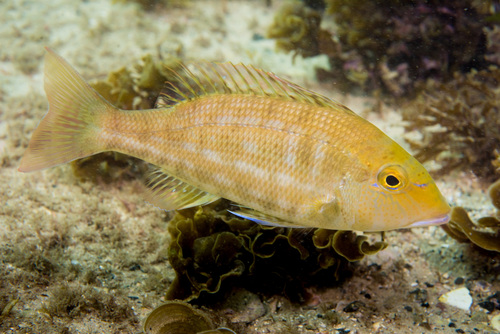
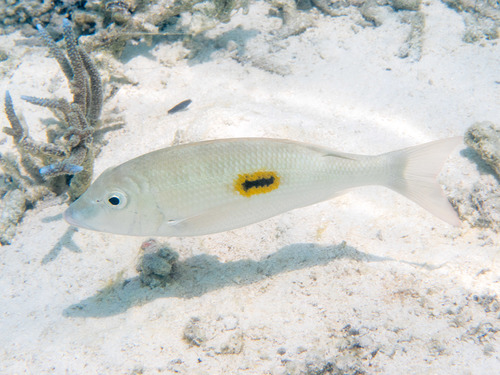
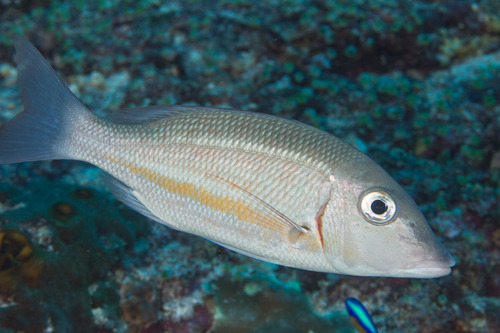
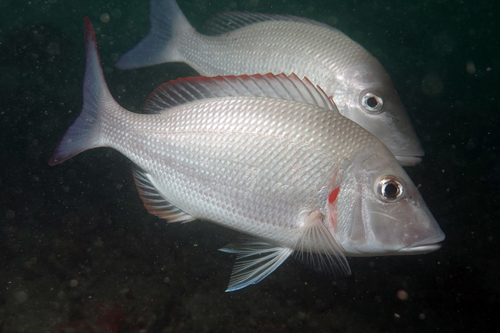
Lethrinus lentjan (Lacepède, 1802) is a large fish species, reaching an approximate maximum length of 50 cm. Specimens found in the intertidal zone are typically around 15 cm. Its body is olive-green, fading to a paler shade toward the belly. It has large scales arranged in a diamond pattern. It has distinct blood-red colouration around the margin of its gill covers, and often also at the base of its pectoral fins. Its dorsal fin is white with a reddish margin. Both the caudal and dorsal fins have orange mottling. Its pectoral fin may be pale orange, whitish, or yellowish. It has thick, fleshy lips, and a somewhat protractile snout.
This species is widespread in the Indo-West Pacific and surrounding waters. It is confirmed to occur in the Red Sea, Persian Gulf, the Great Barrier Reef, the northern half of Australia, lagoons around New Caledonia, along the east coast of Africa, and in waters off Taiwan.
It primarily inhabits coastal areas, occurring on coral reefs, and also living in regions with sandy bottoms, grassy seabeds, mangrove swamps, and deep lagoons. Juveniles are more commonly found in shallow areas, often forming loose groups that include adult specimens. Adults are typically solitary, and can be found in waters up to 84 metres deep. It is fished both commercially and recreationally for human consumption.