About Lethrinus atkinsoni Seale, 1910
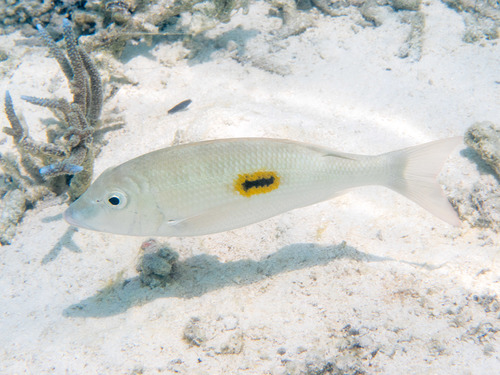
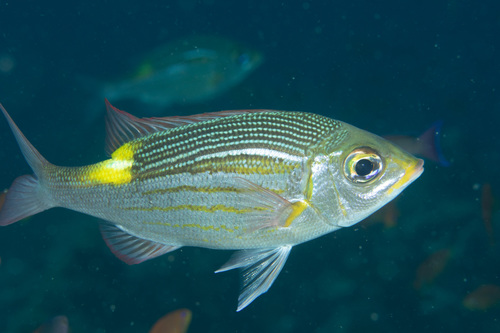
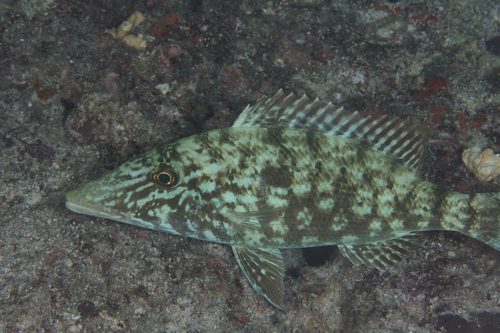
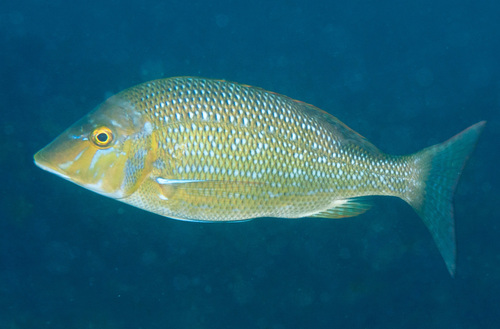
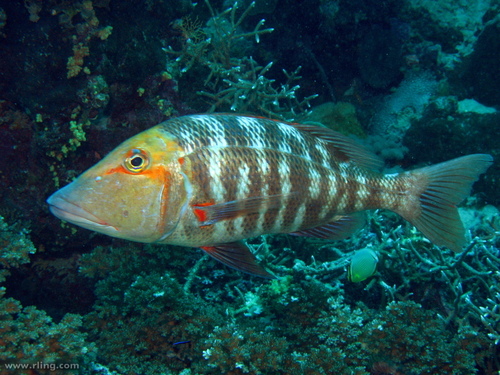
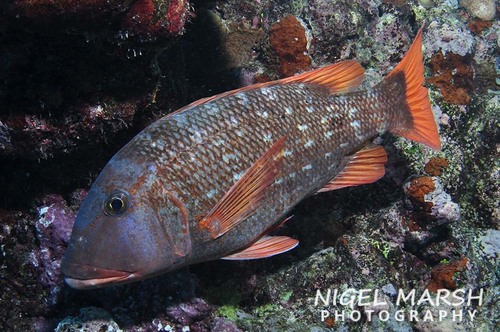
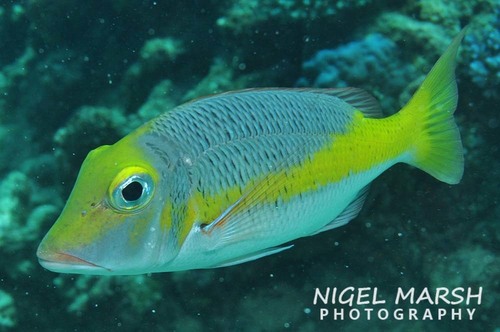
Lethrinus atkinsoni has a continuous dorsal fin supported by 10 spines and 9 soft rays, while its anal fin is supported by 3 spines and 8 soft rays. It has a moderately deep body, with a standard length that is between 2.3 and 2.6 times its body depth. The dorsal profile of the head is clearly convex near the eyes, and the snout is short, blunt, and has a steep, straight profile. This species has a yellow tail and a yellow marking over the eye, and it may have a wide yellow longitudinal stripe along its midflank. The amount of yellow coloring on the caudal peduncle and how far this yellow extends onto the body varies between individuals. The maximum published total length for this species is 50 cm (20 in), though a total length of 32.5 cm (12.8 in) is more typical. Lethrinus atkinsoni is widespread across the western Pacific Ocean, and has been recorded in the waters of Indonesia, the Philippines, New Caledonia, and Japan. It is a non-migratory, reef-associated fish that lives in seagrass beds, on the sandy bottoms of lagoons, and on the outer slopes of coral reefs. It occurs at depths between 0 and 30 metres, and is most commonly found between 2 and 8 metres. This species is caught for subsistence, commercial, and recreational fishing. While it is considered a desirable food fish, other species in its genus are preferred because Lethrinus atkinsoni is smaller in size. It is mainly caught with handlines, trawling, and with nets including shore seines and gillnets. It is mostly marketed fresh, rather than frozen.