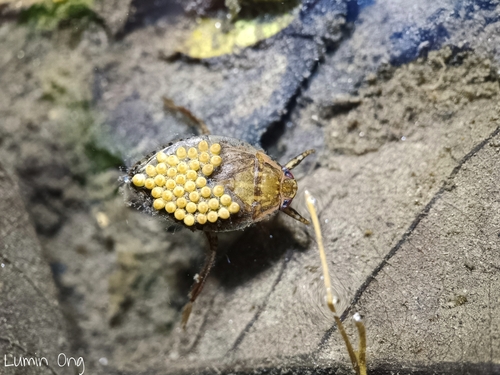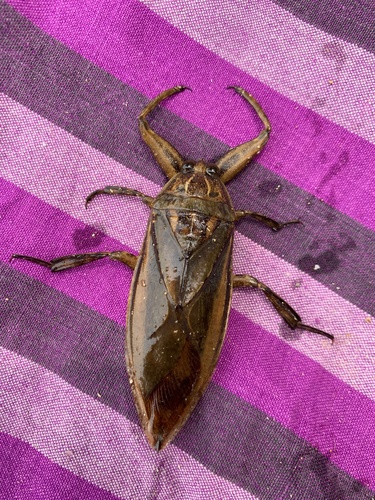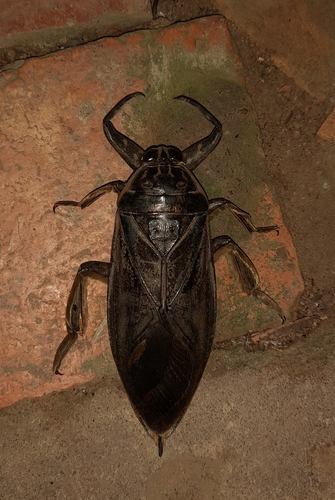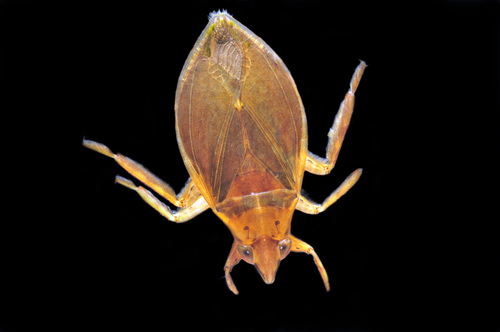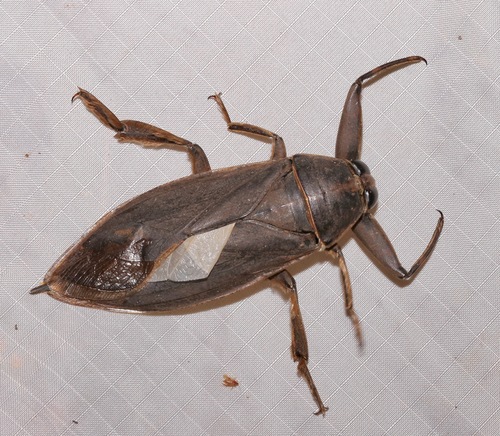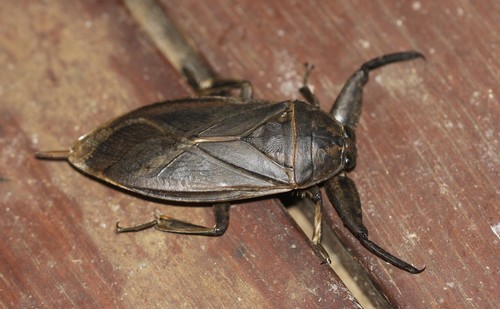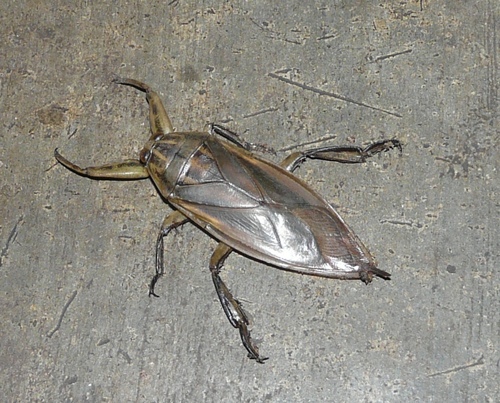
About Lethocerus indicus (Le Peletier & Serville, 1825)
Several species of Belostomatidae occur in the Asian region, including Lethocerus patruelis, Lethocerus insulanus, Lethocerus indicus, and Kirkaldyia deyrolli. L. indicus typically has a body length between 6.5 and 8 cm (2.6 and 3.1 in). Lethocerus insulanus ranges from the islands of Southeast Asia to northern Australia, and has a medial dark stripe between the light stripes of its pronotum. L. patruelis, found from southern Europe to Myanmar, has narrower light stripes, and the first tarsomere on its foreleg is longer than the claw; in L. indicus, these structures are almost equal in length. Kirkaldyia deyrolli is paler than these species and lacks pronotal stripes. The genus Kirkaldyia can be distinguished from Lethocerus by more widely spaced eyes, and the presence of two asymmetrical furrows on the inner setal pad of the fore femur. Lethocerus indicus is widely distributed across peninsular India, Sri Lanka, Bangladesh, and Southeast Asia, extending east to Taiwan and south through Sumatra, Java, Indonesia, the Philippines, and parts of western Papua New Guinea. Glands in the abdomen of this species produce odorous chemicals including (E)-2-hexenyl acetate, (E)-2-hexenyl butanoate, 1-undecen-3-one, 3-mercaptohexyl acetate, and 3-mercapto-1-hexanol; these compounds may act as attractants, particularly for males. The first two compounds are noted to give off a sweet, banana-like scent.