About Lethe diana (Butler, 1866)
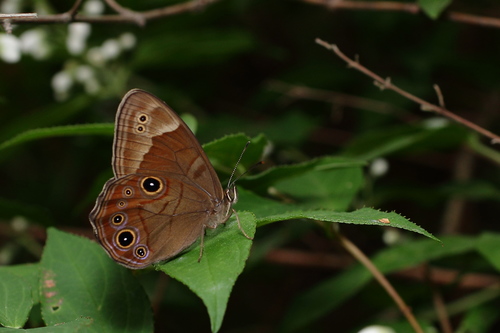
Lethe diana (Butler, 1866) has a wingspan ranging from 45 to 55 mm. Both its forewings and hindwings are dark brown. Forewings sometimes have white belt-like patterns, which are more distinct on female individuals. Darker brown veins are clearly noticeable across the wings. One or two small eyespots are found on the forewings, while the hindwing has six eyespots that vary in size; eyespot patterns mark the outer surface of the hindwings. This species is distributed in Primorye, Sakhalin, and the South Kuril regions of Russia, and in Hokkaido, Honshu, Shikoku, Kyushu, and Tsushima regions of Japan. It inhabits deciduous forests across both flatland and mountain areas. Lethe diana undergoes complete metamorphosis, with four life cycle stages. Host and food plants for adult Lethe diana include Quercus acutissima (saw tooth oak), Quercus serrata (deciduous oak), Phyllostachys nigra (black bamboo), Phyllostachys reticulata, Pleioblastus simonii, Pleioblastus chino, Sasa borealis, Sasa kurilensis (evergreen bamboo), Sasa veitchii, Arundinaria (cane), Poaceae, and Sasa (broadleaf bamboo). It is also known to feed on carrion fluids as part of mud-puddling behavior.