About Letharia vulpina (L.) Hue
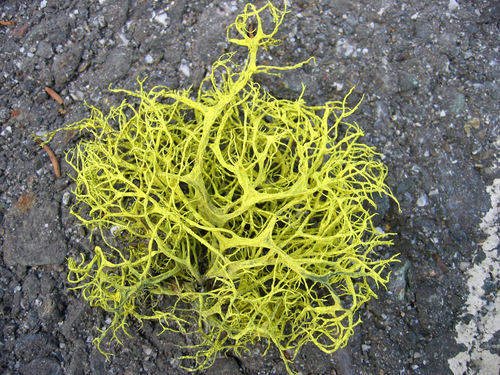
This species, scientifically known as Letharia vulpina (L.) Hue, has a fruticose (shrubby, densely branched) vegetative body called a thallus. Its color ranges from bright yellow to yellow-green or chartreuse, though this color fades in drier specimens. Most thalli reach 2 to 7 cm (0.8 to 3 in) in diameter. Vegetative reproductive structures called soredia and isidia are present, often abundantly, on the surface of thalli. Letharia vulpina is found throughout the Pacific Northwest, where it often grows abundantly on exposed branches that have lost their bark. In old, moist forests, it typically occurs in drier areas, and it has an intermediate level of sensitivity to air pollution. In the Rocky Mountains, Letharia species grow in low-elevation ponderosa forests at the prairie-forest boundary, as well as in medium and high elevation Douglas fir and lodgepole pine forests. The practice of using Letharia vulpina to poison wolves and foxes dates back at least hundreds of years, with the practice recorded in Christoph Gedner's "Of the use of curiosity", published in Benjamin Stillingfleet's 1759 London work Miscellaneous Tracts Relating to Natural History, Husbandry and Physics. British lichenologist Annie Lorrain Smith noted that this poison was made by stuffing reindeer carcasses with the lichen mixed with powdered glass, and suggested the sharp glass edges made internal organs more susceptible to the lichen's poison. Even without added glass, the lichen itself is toxic: powdered lichen mixed with fat and inserted into reindeer carcasses is still fatal to any wolves that eat it. The toxic compound is vulpinic acid, the yellow dye found in the lichen. This chemical is poisonous to all meat-eating animals, but not to mice or rabbits. Some Plateau Indian tribes used this wolf lichen as a poultice to treat swelling, bruises, sores, and boils, and boiled it to make a drink to stop bleeding. Its brightly colored fruiting bodies are also popular for use in floral arrangements.