About Letharia columbiana (Nutt.) J.W.Thomson
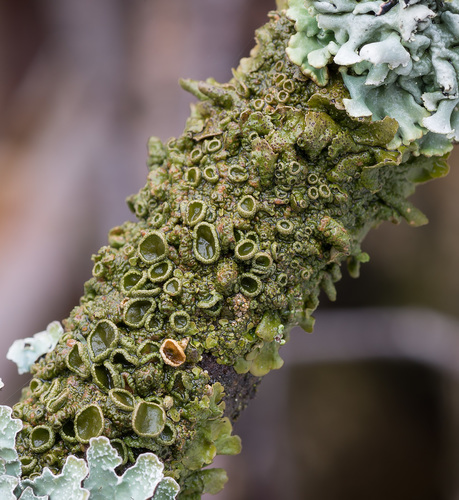
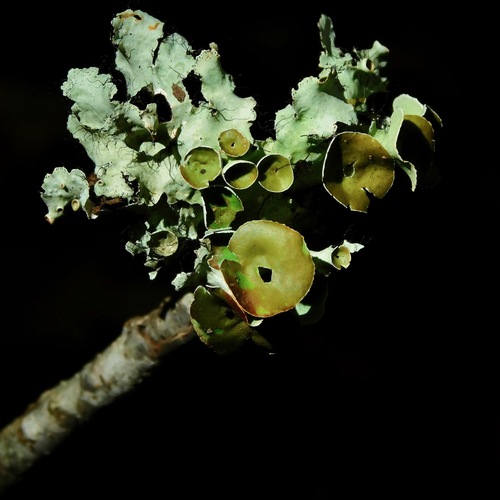
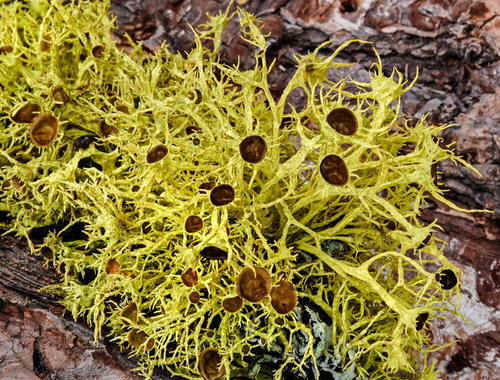
Like all lichens, this ascomycete species grows outward 3–11 cm from the bark it attaches to. It has an intricately, widely branched thallus that forms irregular branches 0.5–3 mm wide with uneven thickness, and a distinct bright yellow-green color. The spiky branches bear visible brown, saucer-shaped fruiting bodies called apothecia, nicknamed “brown eyes”, that produce spores for sexual reproduction. Letharia vulpina lacks these brown spore-producing fruiting bodies, so it cannot reproduce sexually, and this trait is the primary way to distinguish the two species. Letharia columbiana is widely distributed in the subalpine forests of the United States and Canada. It is commonly found from high plateaus and ridges up to timberline, and occurs only occasionally in low-elevation forests. It is abundant across the Pacific Northwest, but appears to avoid areas directly along the coastline. Its full range extends from southern British Columbia south to California, and extends southwest through northern Idaho and western Montana. Lichens are symbiotic organisms made of a fungal partner and a photosynthetic partner, which is either algae or sometimes cyanobacteria; only the fungal partner of a lichen reproduces sexually via spores. After release, new ascospores must find a new compatible photosynthetic partner to form a new symbiotic lichen. Letharia columbiana does not produce many asexual reproductive structures, and instead forms apothecia, a specific type of ascocarp (fungal fruiting body for spore production). An apothecium is a wide, saucer-shaped structure that has three distinct parts: the hymenium, hypothecium, and excipulum. The hymenium, which is the fertile reproductive layer of the apothecium, is made up of spore-producing asci. Different apothecia can use different spore dispersal strategies, which leads to different arrangements of asci inside the structure. However, there is currently insufficient research on L. columbiana asci to confirm what ascus arrangement this species has.