About Lestes barbarus (Fabricius, 1798)
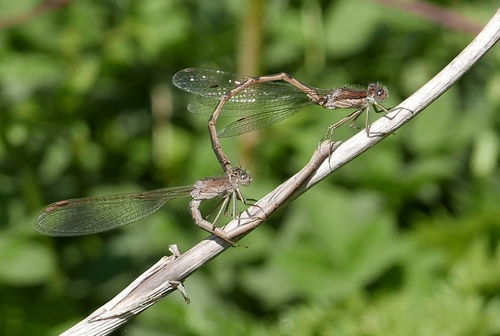
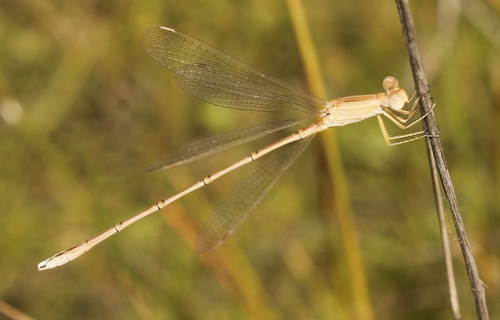
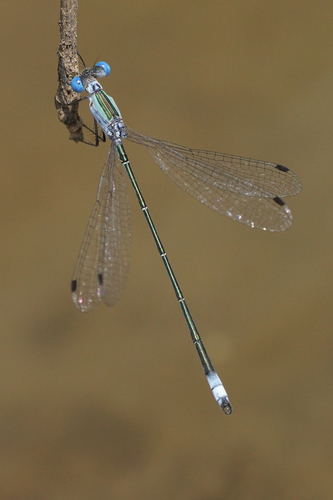
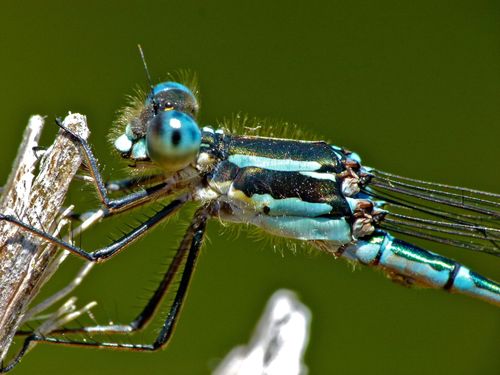
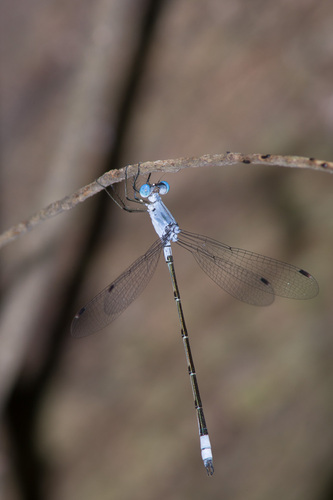
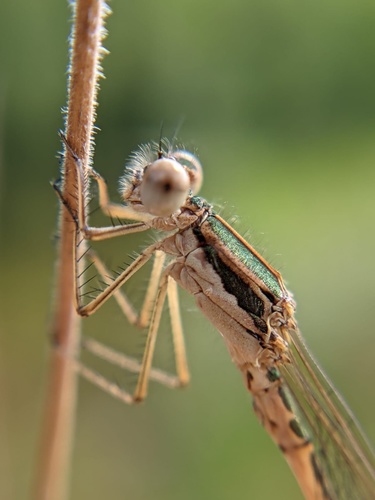
Identification: This species has the typical appearance of a Lestes damselfly: it has a metallic green body, and holds its wings away from the body when at rest. Unlike other European Lestes damselflies, this species has diagnostic bicolored pterostigmata. The male abdominal appendages and female ovipositor are also characteristic, differing from those of L. sponsa and L. dryas. Immature individuals have pale pterostigmata, and only develop the characteristic two-colored pterostigmata once they reach maturity.
Distribution and habitat: Lestes barbarus is a European-central Asian species, with isolated populations in North Africa, and its range is currently expanding northward. Its continuous range stretches across a band of southern Europe covering Spain, France, Italy and Greece, extending east to India and Mongolia. It is less common in northern Europe, though individuals have been found as far north as Sweden. In the Netherlands, it breeds in coastal dunes and its population is increasing. It occurs at the edge of its range in the Channel Islands, where it has bred since 1995. It is also found in North Africa; it got its Latin name because the first known specimen was collected in Barbary, North Africa. It is a damselfly that occupies still water habitats, and can be found in stagnant and slightly brackish water. This species was first recorded in Britain at Winterton Dunes, Norfolk, on 30 July 2002. It was observed at Sandwich Bay, Kent, in 2003 and 2004. In 2018, it was confirmed to have bred in Britain for the first time.