About Lessonia rufa (Gmelin, 1789)
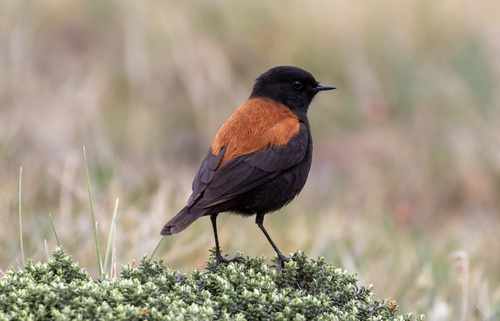
The austral negrito, scientifically named Lessonia rufa (Gmelin, 1789), measures 11.5 to 12.5 cm (4.5 to 4.9 in) in total length. Adult males are mostly black, with a rufous-chestnut colored back. Their flight feathers are solid black, and lack the pale inner webs seen on the flight feathers of the Andean negrito. Adult females are smaller than males, with a brownish gray crown, white supercilium and cheek, and a dark brown "collar" across the nape and upper back. Their lower back is dull rufous-brown. Their wings and tail are black, with whitish edges on the outer web of the outermost tail feathers. Females have a whitish chin, buffy white breast marked with grayish brown streaks, buff flanks and belly, and a whitish vent area. Juveniles resemble adult females, but have a back that is more rufescent in tone. Both sexes have a dark iris, a short black bill, and black legs and feet. They have exceptionally long hindclaws, similar to those of a pipit. The austral negrito is distributed along the full length of Chile, reaching as far south as Cape Horn. It also occurs from south-central Bolivia south through Argentina to Tierra del Fuego, across southern Paraguay, in far southern Brazil, and in Uruguay. Vagrant individuals have been recorded in Peru and the Falkland Islands. There is also one confirmed record from King George Island in the South Shetland Islands, and one record of the species at sea near Antarctica. This bird inhabits open grassy landscapes at the margins of lakes and marshes, as well as coastal lagoons, beaches, and pastures. Most populations of the austral negrito occur below 1,000 m (3,300 ft) in elevation, though it can be found locally as high as 2,000 m (6,600 ft).