About Lepus townsendii Bachman, 1839
Scientific name: Lepus townsendii Bachman, 1839
Description: The white-tailed jackrabbit is a large species of hare, and the largest species commonly called "jackrabbit". Two larger hare species, the Arctic hare and Alaskan hare, are found further north in North America. Adult white-tailed jackrabbits measure 56 to 65 cm (22 to 26 in) in total length, which includes a tail that is 6.6 to 10.2 cm (2.6 to 4.0 in) long, and weigh between 2.5 and 4.3 kg (5.5 and 9.5 lb).
From winter to spring, female weight tends to increase due to pregnancy, while male weight tends to decrease due to the stresses of reproductive competition. As an example of this pattern, females in Iowa average 3,600 g (7.9 lb) in winter and 3,800 g (8.4 lb) in spring, while males average 3,400 g (7.5 lb) in winter and 3,100 g (6.8 lb) in spring. At the northernmost edge of this species' range, individuals can be almost twice as large as specimens from the middle of its range. Rare specimens over 9 kg (20 lb) have been recorded in Saskatchewan.
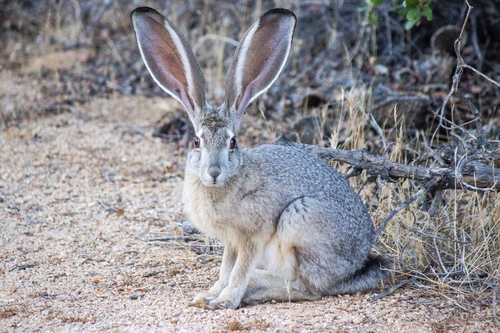
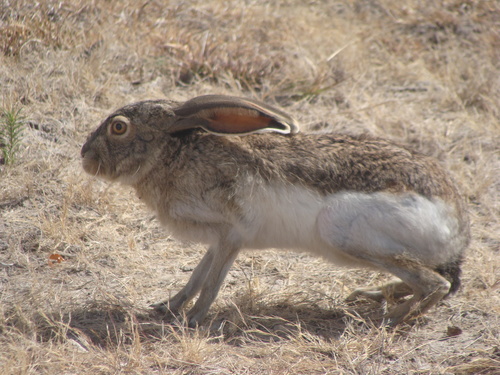
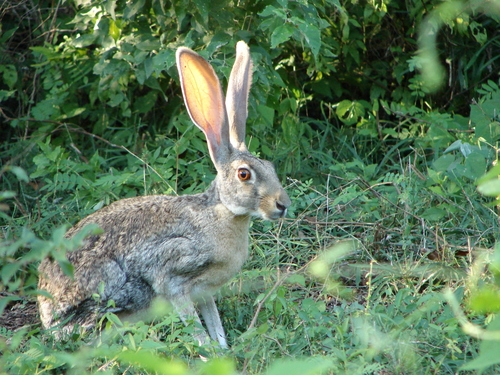
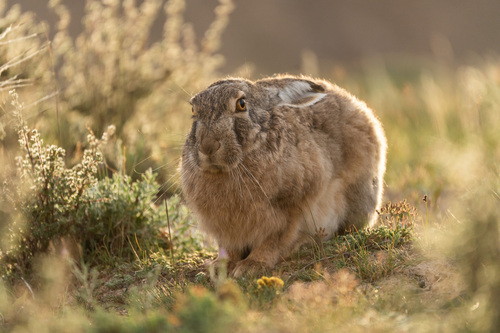
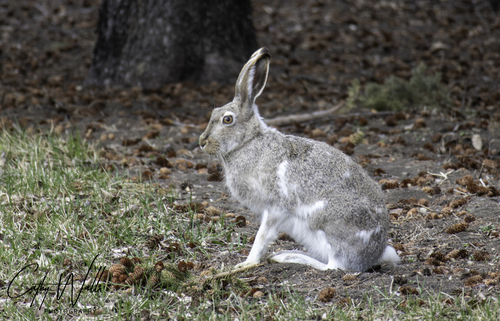
This species has distinctive large grey ears with black tips; the inner ear surface is chestnut brown and white. It also has the long, powerful hind legs that are characteristic of hares. Its back, flanks, and limbs are dark brown or greyish-brown, and its underparts are pale grey. Measured from the notch, ears range from 10 to 11.3 cm (3.9 to 4.4 in) long, and hindfeet range from 14.5 to 16.5 cm (5.7 to 6.5 in) long. The tail is white, with a dark central stripe on its upper surface. Females are slightly larger than males. In northern populations, this hare moults in autumn and turns completely white all over its body except for its ears. These hares generally do not make sound, but will emit a shrill scream when injured or caught.
Distribution and habitat: The white-tailed jackrabbit is native to western and central North America. In Canada, its range includes British Columbia, Alberta, Saskatchewan, Manitoba, and Ontario. In the United States, its range includes Washington, Oregon, California, Nevada, Utah, Idaho, Montana, Wyoming, Colorado, New Mexico, North Dakota, South Dakota, Nebraska, Kansas, Minnesota, Wisconsin, Iowa, Missouri, and Illinois. It inhabits plains, prairies, and alpine meadows with scattered coniferous trees, and occurs up to an elevation of about 3,000 m (10,000 ft) in Colorado.
The white-tailed jackrabbit is slightly larger than the black-tailed jackrabbit (Lepus californicus). Where their ranges overlap, the two species are segregated by habitat: the white-tailed jackrabbit tends to live at higher altitudes, while the black-tailed jackrabbit occupies more arid lowland habitats. White-tailed jackrabbits are often seen in urban and suburban parks across Western Canada. In spring, people often encounter single young jackrabbits during the day and mistakenly assume they have been abandoned by their mothers. The Edmonton Humane Society has issued public statements asking that people not bring these bunnies to animal shelters.
Ecology: Through their selective grazing, white-tailed jackrabbits influence the composition of local turf vegetation. They are an important prey species for a wide range of mammalian predators. Red foxes (Vulpes vulpes) and grey foxes (Urocyon cinereoargenteus) occasionally capture white-tailed jackrabbits, though they do not catch many large adults. This species is a particularly important prey source for mid-sized carnivores including the American badger (Taxidea taxus), coyote (Canis latrans), and bobcat (Lynx rufus), and acts as a small supplemental prey source for larger carnivores such as the mountain lion (Puma concolor) and gray wolf (Canis lupus).
Snakes sometimes attack white-tailed jackrabbits, usually targeting young individuals. Avian predators include eagles, hawks, and owls. Golden eagles (Aquila chrysaetos) and bald eagles (Haliaeetus leucocephalus) are the only bird predators large enough to regularly hunt full-grown white-tailed jackrabbits. Ferruginous hawks (Buteo regalis) and great horned owls (Bubo virginianus) may occasionally take an adult, but these two species and other medium-large raptors typically hunt young jackrabbits. To avoid detection, white-tailed jackrabbits crouch in vegetation, where their cryptic colouration makes them hard to spot. They may slink away quietly if undisturbed, but if detected, they bound away at speed along a zigzag course. They can run at speeds up to 55 km/h (34 mi/hr) and leap up to 5 m (16 ft). Humans also hunt and eat white-tailed jackrabbits.