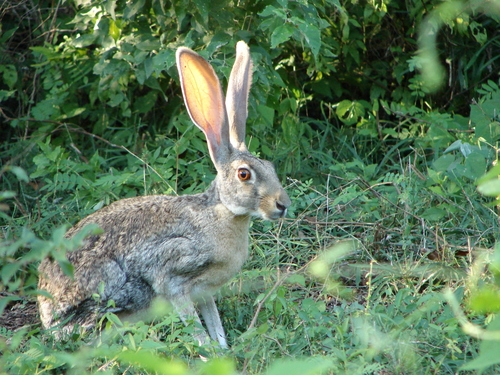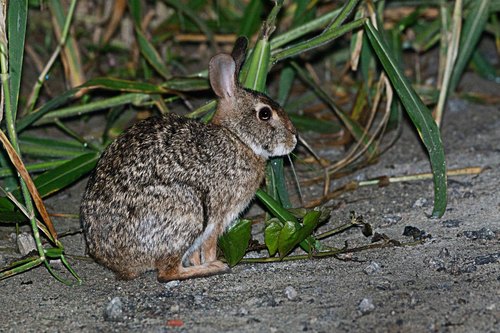
About Lepus timidus Linnaeus, 1758
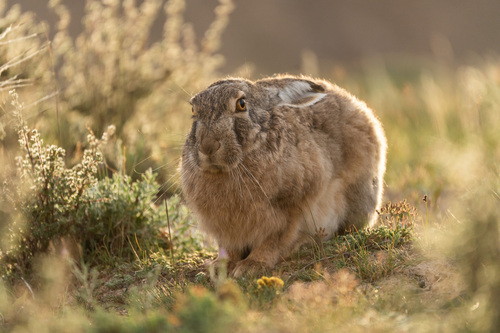
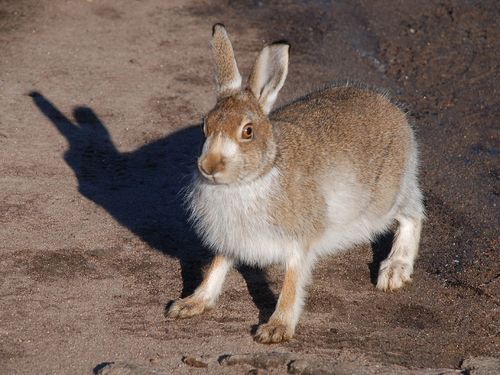
The mountain hare (scientific name Lepus timidus Linnaeus, 1758) is a large hare species that is slightly smaller than the European hare. Adults reach a length of 45–65 cm (18–26 in), with a 4–8 cm (1+1⁄2–3 in) tail, and weigh 2–5.3 kg (4+1⁄2–11+3⁄4 lb); females are slightly heavier than males. Mountain hares can live up to 12 years. For all populations, summer coats are various shades of brown. Most populations moult into a fully or mostly white winter coat in preparation for winter. The mountain hare’s tail stays completely white year-round, which distinguishes it from the European hare (Lepus europaeus), whose tail has a black upper side. The subspecies Lepus timidus hibernicus, the Irish mountain hare, is smaller in size and stays brown year-round. Irish hares may also have a golden colour variation, particularly individuals found on Rathlin Island. Mountain hares living in the Faroe Islands turn grey instead of white in winter; this winter grey colour may be caused by downregulation of the agouti hair cycle isoform during the autumn moult. This species is naturally distributed from Fennoscandia to eastern Siberia, with isolated mountain populations occurring in the Alps, Scotland, the Baltics, northeastern Poland, and Hokkaidō. In Ireland, the subspecies L. t. hibernicus lives not just in mountains, but also in lowland pastures, coastal grasslands, and salt marshes. The mountain hare has also been introduced to Iceland, Shetland, Orkney, the Isle of Man, the Peak District, Svalbard, the Kerguelen Islands, the Crozet Islands, and the Faroe Islands. In the Alps, the mountain hare lives at elevations from 700 to 3,800 m (2,300 to 12,500 ft), varying by geographic region and season. The mountain hare’s diet varies by region, and is somewhat dependent on the specific habitat of the studied population. For example, in northern Scandinavia, where snow may cover the ground for many months, hares may feed on twigs and bark. In areas with rare snowfall, such as Ireland, grass may make up the bulk of the diet. When given a choice, mountain hares in Scotland and Ireland prefer grazing on grasses. In a coastal grassland environment in Ireland, grasses made up over 90% of the mountain hare diet, a higher percentage than that recorded for European rabbits (Oryctolagus cuniculus) inhabiting the same environment. The mountain hare is a favorite prey of the golden eagle in parts of its range; it is also hunted by Eurasian eagle-owls and red foxes, and stoats may prey on young mountain hares. In southern parts of Finland, Norway, and Sweden, the mountain hare competes for habitat with the European hare. The larger European hare can usually drive away the mountain hare, but it is less adapted to live in snowy regions, with smaller feet and winter fur that is a mixture of white and brown. This mixed winter fur works well as camouflage in coastal regions of Finland, where snow only covers shrubs for a short time, while the mountain hare is better adapted to the snowier conditions of inland areas. Mountain hares and European hares may occasionally interbreed. The Arctic hare (Lepus arcticus) was once classified as a subspecies of the mountain hare, but it is now recognized as a separate species. Similarly, some scientists consider the Irish hare to be a separate species. Fifteen subspecies of Lepus timidus are currently recognized.