About Lepus callotis Wagler, 1830
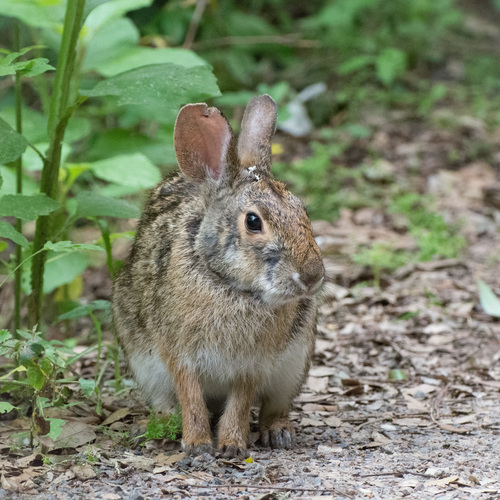
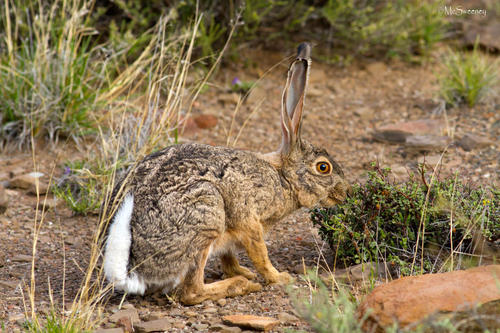
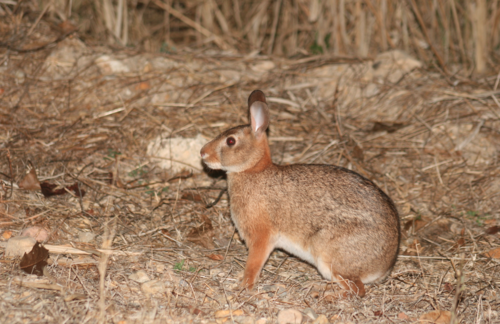
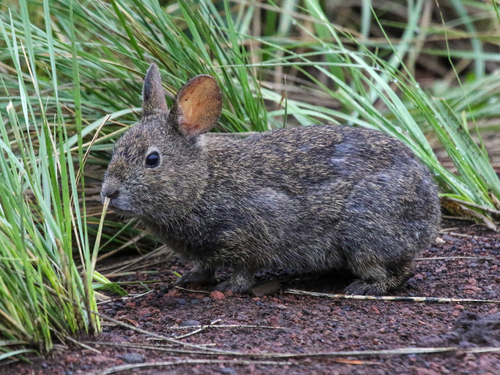
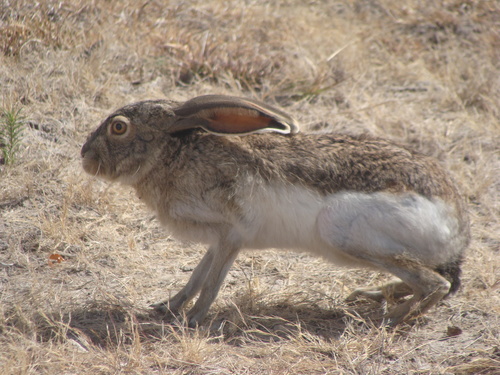
The white-sided jackrabbit, scientifically known as Lepus callotis Wagler, 1830, has an adult body length ranging from 16 to 30 inches (41 to 76 cm). Its tail reaches 1 to 4 inches (2.5 to 10.2 cm) in length. Front legs grow 4 to 6 inches (10 to 15 cm) long, while back legs reach 6 to 12 inches (15 to 30 cm) in length. Fully grown ears measure 2 to 6 inches (5.1 to 15.2 cm). This species has five toes on its fore paws and four toes on its back paws, and all toes end in sturdy claws. Sexual dimorphism occurs in white-sided jackrabbits, with females generally larger than males. The dorsal fur of the white-sided jackrabbit is short and coarse, colored pale cinnamon heavily mixed with black. Underparts are white, with faint colored patches on the front of the thighs. The upper surface of the tail has black hairs tipped with white, and the entire underside of the tail is white. The species is named for its distinctive pure white sides, a feature that sets it apart from related species. The rump and thighs are also white, lined with a small number of black hairs. A median black line divides the rump, and this line is concealed by sooty, brownish, and white-tipped hairs. The limbs are white, but their outer surfaces are stained buff. The gular pouch is also buffy, while the sides of the neck and shoulders take on a more ochraceous color. The head is cream buff mixed with black, with whitish areas around the sides of the eyes. Ears are covered in short yellowish-brown hairs that are mixed with black on the anterior section and white on the posterior section. The ear apex is white-tipped, with a tuft of black hair just below the apex. The long fringes on the anterior edge of the ear are ochraceous buff, while fringes on the ear tip and posterior edge are white. The inner surface of the ear is almost entirely bare, with only a dusky spot on the posterior border. The nape is ochraceous buff. The winter pelage of the white-sided jackrabbit differs from the summer coat: the rump, back, and outside of the hind legs are iron gray. The front of the hind legs and the tops of the feet are white. The front of the fore legs and top of the fore feet range from pale gray to dull iron-gray. The median black line on the rump is not clearly distinguishable and does not extend much beyond the base of the tail. The top, sides, and tip of the tail are black, while the underside is two-thirds white and one-third black. The top and sides of the head and back are dark-pinkish buff overlaid with black. The nape is usually black. Ears are dark buff, black, and white. The front border of the ears is fringed with buff or ochraceous buff hairs, while the posterior border and tip are white. The underside of the neck is dark grayish buff, and all other underparts including the flanks are white. The white-sided jackrabbit inhabits high-elevation plateaus, including the grassy plains of southwestern New Mexico and the open plains of the southern Mexican tableland. It avoids hilly or mountainous areas, prefers flat, grass-dense land, and also avoids areas with trees and shrubs. The breeding season of the white-sided jackrabbit lasts at least 18 weeks, from mid-April to mid-August. Litters average around two young. Juveniles have a soft, woolly coat early in life and reach sexual maturity quickly. Breeding does not occur for L. callotis within the first calendar year after birth. The diet of the white-sided jackrabbit consists primarily of grasses, including buffalograss, tobosagrass, fiddleneck, wolftail, blue grama, vine mesquite, ring muhly, wooly Indian wheat, and Wright buckwheat. The only major non-grass food item in their diet is sedge nutgrass.