About Lepus californicus Gray, 1837
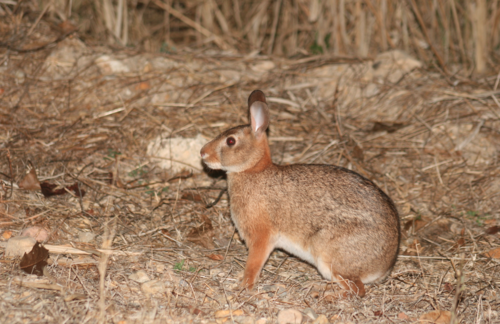
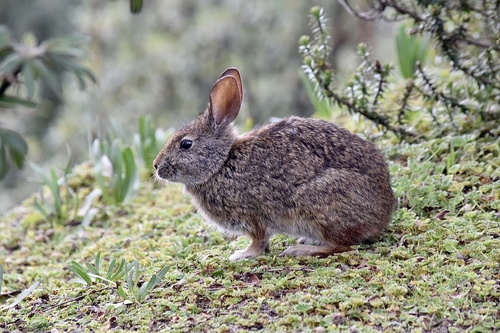
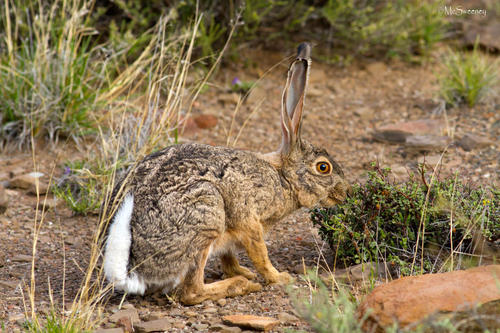
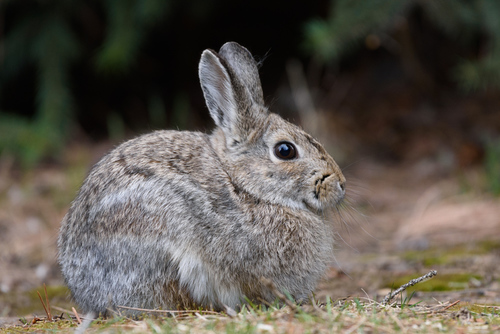
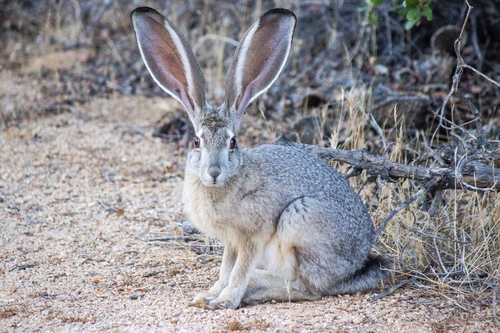
Black-tailed jackrabbit (Lepus californicus Gray, 1837), a hare species, shares the distinctive long ears and long powerful rear legs typical of other jackrabbits and hares. It reaches about 2 feet (61 cm) in length and weighs 3 to 6 pounds (1.4 to 2.7 kg), making it the third-largest North American jackrabbit, ranking after the antelope jackrabbit and the white-tailed jackrabbit. The far more northerly Arctic hare and Alaskan hare, which are also members of the hare genus, are somewhat larger than all jackrabbit species. The black-tailed jackrabbit has agouti dorsal fur: dark buff fur peppered with black. Its undersides and the insides of its legs are creamy white. The outer surfaces of its ears have black tips, while the inner surfaces are unpigmented. The ventral surface of its tail ranges from grey to white, and the black dorsal surface of the tail extends a few inches up the spine to form a short black stripe. Females are larger than males, with no other notable physical differences between the sexes. Currently, 17 subspecies of Lepus californicus are recognized, though this number may be excessive. When Dixon and other researchers used cluster analysis of anatomical traits, they found that black-tailed jackrabbit subspecies split into two distinct groups, geographically separated west and east of the Colorado Rocky Mountains and the Colorado River. They concluded that only two infrataxa are justified: the western subspecies L. c. californicus and the eastern subspecies L. c. texianus. The black-tailed jackrabbit is the most widely distributed jackrabbit (Lepus species) in North America. Its native populations range from central Washington east to Missouri, and south to Baja California Sur and Zacatecas. The species' range is currently expanding eastward into the Great Plains, displacing the white-tailed jackrabbit. It has also been successfully introduced to southern Florida, and along the coastline of Maryland, New Jersey, and Virginia. Six subspecies are found on the Baja California Peninsula, three of which are endemic to the peninsula's surrounding islands. The current distribution of these populations formed after sea-level rise around 21,000 years ago, following the Last Glacial Maximum. This event created geographic isolation, and the peninsula's Lepus californicus subspecies can now be divided into three subclades based on shared DNA structure and pelage color. The first subclade is associated with the subspecies L. c. xanti, includes all subspecies in the southernmost part of the Baja Peninsula, and has a yellowish color pattern. The second subclade is associated with L. c. magdalenae, includes all subspecies found between the La Paz isthmus and the southern Vixcaino Desert (including L. c. xanti, L. c. sheldoni, and L. c. martirensis), and has a coloration ranging from light brown to yellow. The third subclade is associated with L. c. martirensis, and includes all subspecies found from the Viscaino Desert to the northernmost point of the peninsula. The recognized subspecies occurring fully or partially in the United States are: L. c. altamirae (Nelson), L. c. asellus (G. S. Miller), L. c. bennettii (Gray) – distributed from coastal southern California to Baja California Norte, L. c. californicus (Gray) – distributed from coastal Oregon to coastal and Central Valley California, L. c. curti (E. R. Hall), L. c. deserticola (Mearns) – distributed from southern Idaho to Sonora, L. c. ememicus (J. A. Allen) – distributed from central Arizona to Sonora, L. c. festinus (Nelson), L. c. magdalenae (Nelson), L. c. martirensis (J. M. Stowell), L. c. melanotis (Mearns) – distributed from South Dakota to Iowa, Missouri, and central Texas, L. c. merriamai (Mearns) – distributed from south-central and southeastern Texas to Tamaulipas, L. c. richardsonii (Bachman) – distributed in central California, L. c. sheldoni (W. H. Burt), L. c. texianus (Waterhouse) – distributed from southeastern Utah and southwestern Colorado to Zacatecas, L. c. wallawalla (Merriam) – distributed from eastern Washington to northeastern California and northwestern Nevada, L. c. xanti (Thomas). Black-tailed jackrabbits can occupy a wide range of habitats, so long as the area contains a diversity of plant species. They require mixed grasses, forbs, and shrubs for food, and shrubs or small trees for cover. They prefer moderately open areas with no dense understory growth, and are very rarely found in closed-canopy habitats. For example, in California, black-tailed jackrabbits are abundant in open chamise (Adenostoma fasciculatum) and Ceanothus spp. chaparral that is interspersed with grasses, but do not live in closed-canopy chaparral. Similarly, they occupy clearcuts and early seral coniferous forest, but not closed-canopy coniferous forest. Black-tailed jackrabbits do not migrate or hibernate during winter, and use the same habitat year-round. They make daily movements of 2–10 miles (3.2–16.1 km), moving from shrub cover during the day to open foraging areas at night. Their home range size varies with habitat and habitat quality; home ranges of 0.4–1.2 square miles (1.0–3.1 km2) have been recorded in big sagebrush (Artemisia tridentata) and black greasewood (Sarcobatus vermiculatus) communities in northern Utah. They need shrubs or small conifers for hiding, nesting, and thermal cover, and grassy areas for night feeding. A shrub-grassland mosaic, or widely spaced shrubs interspersed with herbs, provides hiding cover while also allowing feeding opportunities. Small shrubs do not provide enough adequate cover. In the Snake River Birds of Prey Study Area in southwestern Idaho, black-tailed jackrabbits were more common on sites dominated by big sagebrush or black greasewood than on sites dominated by the smaller shrubs winterfat (Krascheninnikovia lanata) or shadscale (Atriplex confertifolia). Black-tailed jackrabbits do not habitually use burrows, though they have occasionally been observed using abandoned burrows for escape and thermal cover. The black-tailed jackrabbit's diet is made up of shrubs, small trees, grasses, forbs, and some fungi. Over the course of a year, they feed on most if not all of the dominant plant species in their communities. A plant's growth stage and moisture content tend to influence their selection more than plant species. Shrubs generally make up the bulk of their fall and winter diets, while grasses and forbs are the main food source in spring and early summer. This pattern changes with climate: herbaceous plants are grazed during greenup periods, when the plants are in pre-reproductive to early reproductive stages, and shrubs are used more often during dry seasons. However, shrubs are browsed year-round. Most of a black-tailed jackrabbit's daily water intake comes from water-rich vegetation they forage. Jackrabbits require plants where the water weight is at least five times the dry weight to meet their daily water needs. For this reason, black-tailed jackrabbits switch to feeding on phreatophyte (deep-rooted) shrubs when herbaceous vegetation is recovering after foraging. Plant species eaten by black-tailed jackrabbits are well documented for desert regions, but forage use in other regions is less well understood. In non-desert regions, black-tailed jackrabbits browse seedlings of Douglas fir (Pseudotsuga menziesii), ponderosa pine (Pinus ponderosa), lodgepole pine (P. contorta), western hemlock (Tsuga heterophylla), and oak (Quercus spp.) seedlings and sprouts.