About Lepus arcticus Ross, 1819
Description: The Arctic hare (Lepus arcticus Ross, 1819) is one of the largest living lagomorphs. This species typically reaches a total body length of 43 to 70 cm (17 to 28 in), not including a tail that measures 4.5 to 10 cm (1.8 to 3.9 in). Its typical body mass ranges between 2.5–5.5 kg (6–12 lb), though exceptionally large individuals can weigh up to 7 kg (15 lb).
Distribution and habitat: The Arctic hare is found across the northernmost regions of Greenland, the Canadian Arctic islands including Ellesmere Island, and Northern Canada, with populations extending farther south into Labrador and Newfoundland. It is well adapted to the cold weather and frozen precipitation of the tundras, plateaus, and treeless coasts that make up its native range. It can be found at elevations from sea level up to 900 m (3,000 ft).
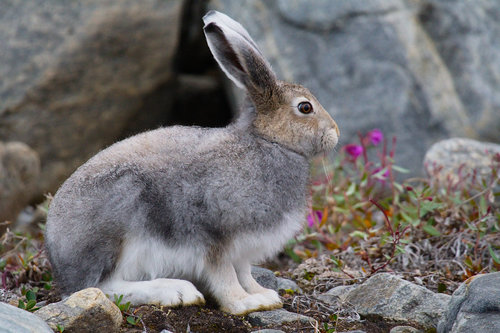
In Newfoundland and Southern Labrador, Arctic hares change coat color through seasonal moulting: they grow brown or grey fur in summer, then moult to grow new white fur for winter. This seasonal moulting for camouflage matching changing environments is also seen in other Arctic animals, including ermine and ptarmigan. However, Arctic hares living in the far north of Canada, where summer is very short, remain white year-round.
Reproduction and lifespan: The Arctic hare's breeding season falls around April or May. Its gestation period is 53 days, so young are born between May and July. Litters can have up to eight young, called leverets, with an average litter size of 5.4. Leverets remain within their mother's home range until they are able to survive independently. Young Arctic hares are almost full-sized by late July, just a few weeks after birth, and breed for the first time when they reach one year of age. There is little confirmed information about the lifespan of wild Arctic hares. Anecdotal evidence suggests wild individuals live three to five years. Arctic hares do not survive well in captivity, with a maximum lifespan of only one and a half years.