About Lepus americanus Erxleben, 1777
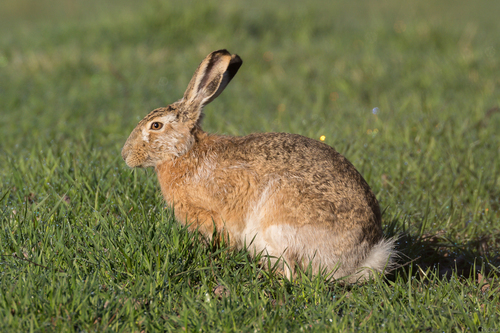
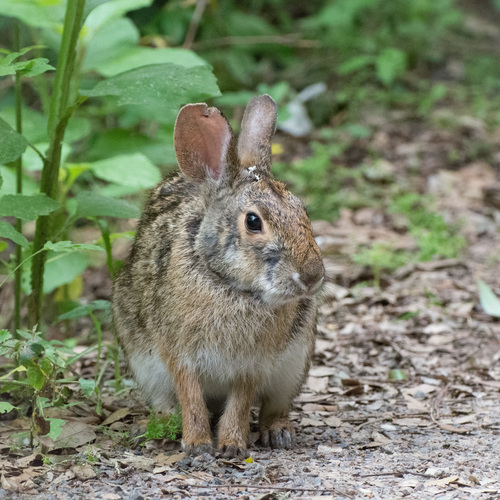
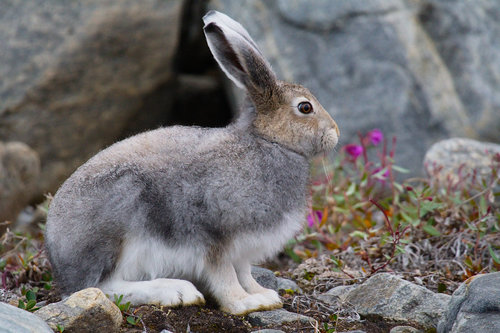
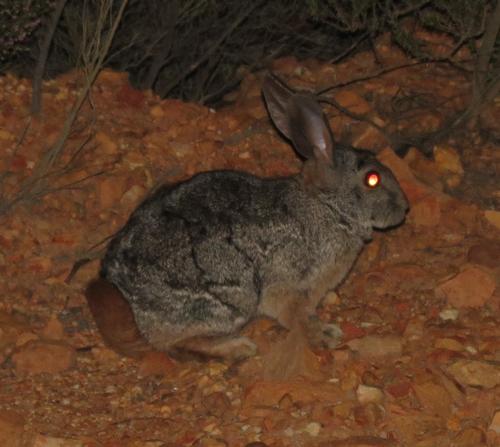
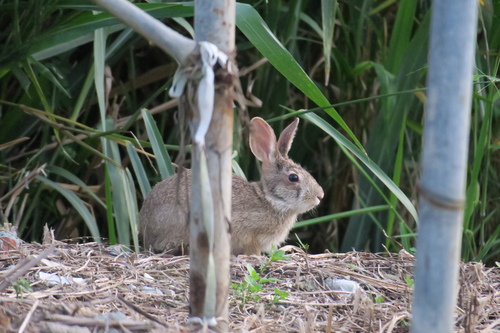
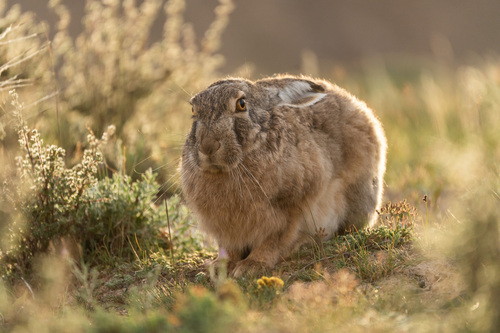
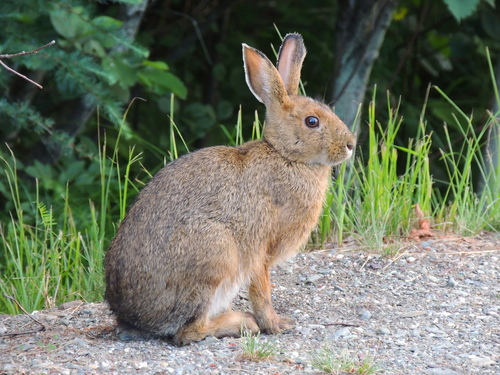
Scientific name: Lepus americanus Erxleben, 1777. Description: The snowshoe hare’s fur changes color seasonally: it is rusty brown in spring and summer, turning bright white in winter to blend in with snow. It always has a gray underbelly, and black markings on the tips and edges of its ears and tail. It has very large hind feet with dense fur on their soles, and its ears are shorter than those of many other hare species. Snowshoe hares measure 413 to 518 mm (16.3 to 20.4 in) in total length, with tails 39 to 52 mm (1.5 to 2.0 in) long. Their long, broad hind feet are 117 to 147 mm (4.6 to 5.8 in) long, and their ears measure 62 to 70 mm (2.4 to 2.8 in) from notch to tip. They usually weigh between 1.43 and 1.55 kg (3.15 to 3.42 lb), and as is typical for leporids, males are slightly smaller than females. In summer, their coat is a grizzled rusty or grayish brown, with a blackish middorsal line, buffy flanks and a white belly. Their face and legs are cinnamon brown, and their ears are brownish with black tips and white or creamy borders. In winter, their fur is almost entirely white, except for black eyelids and black ear tips. The soles of their feet are densely furred, and stiff hairs on the hind feet form the characteristic "snowshoe" structure. Distribution: Snowshoe hares range from Newfoundland to Alaska, extending south through the Sierra Nevada to central California, through the Rocky Mountains to southern Utah and northern New Mexico, and through the Appalachian Mountains to West Virginia. Populations in the southern part of their range, including Ohio, Maryland, North Carolina, New Jersey, Tennessee, and Virginia, have been extirpated. Habitat: Snowshoe hares are primarily found in areas with dense plant coverage, such as boreal forests, upper montane forests, and wetlands, though they are occasionally seen in more open areas like agricultural land. In northern Utah within the range of Gambel oak (Quercus gambelli), snowshoe hares use this species. The southernmost populations of snowshoe hares in the Southwest are located in the Sangre de Cristo Mountains, New Mexico, where they live in subalpine scrub: narrow bands of shrubby and prostrate conifers at and just below timberline, usually made up of Engelmann spruce, bristlecone pine, limber pine, and juniper. In Minnesota, they are found in both uplands and wetlands. In New England, they favor second-growth forests. The main factors that determine habitat quality are average visual obstruction and browse biomass. Snowshoe hares prefer young forests with abundant understories. The presence of adequate cover is the primary determinant of habitat quality, and is more important than food availability or plant species composition. That said, plant species composition does influence population density: dense softwood understories support higher snowshoe hare density than hardwood understories, due to better cover quality. In Maine, female snowshoe hares are more commonly found on sites with less cover but more nutritious forage, while males tend to occupy sites with heavier cover. Winter browse availability depends on the height of understory brush and winter snow depth; 6-to-8-foot-tall (1.8 to 2.4 m) saplings with narrow stem diameters are required for winter browse in heavy snow. In northern regions, snowshoe hares live in conifer and mixed forests of all successional stages, but early successional forests support the highest population abundance. Deciduous forests are usually only occupied in early successional stages. In New England, snowshoe hares prefer second-growth deciduous, coniferous, and mixed woods with dense brushy understories; they also favor shrubby old-field areas, early- to mid-successional burns, shrub-swamps, bogs, and upper montane krumholz vegetation. In Maine, snowshoe hares are more active in clearcut areas than in partially cut or uncut areas. The highest sapling densities occur on 12- to 15-year-old plots, and these plots are used more often than younger stands. In northern Utah, they occupy all later successional stages on quaking aspen and spruce-fir, but are not found in meadows. In Alberta, snowshoe hares use the upland shrub-sapling stages of regenerating aspens, both after fire and after harvest. In British Columbia, overstocked juvenile lodgepole pine (Pinus contorta) stands form optimal snowshoe hare habitat. In western Washington, most unburned, burned, or scarified clearcuts are normally fully occupied by snowshoe hares within four to five years, once vegetation becomes dense. In stands older than 25 years, stem density begins to decline and the cover snowshoe hares need decreases. However, in north-central Washington, snowshoe hares may not colonize clearcuts until six or seven years, and it can take 20 to 25 years for their population density to reach a maximum. Winter pellet counts show the highest snowshoe hare density in 20-year-old lodgepole pine stands, lower density in older lodgepole stands, and the lowest density in spruce-dominated stands. In western Oregon, snowshoe hares are only abundant in early successional stages, including stable brushfields. In west-central Oregon, an old-growth Douglas-fir forest was clearcut and monitored through 10 years of succession. Only a few snowshoe hares were recorded in adjacent virgin forest plots, where they occurred as widely scattered, sparse populations. One snowshoe hare was observed on the disturbed plot 2.5 years after clearcutting and burning, when ground cover was similar to that of the uncut forest. By 9 years after disturbance, snowshoe hare density had increased markedly. In western Washington, snowshoe hares regularly use steep slopes when adequate cover is present, though most studies indicate they generally prefer gentle slopes. Moonlight increases snowshoe hares' vulnerability to predation, especially in winter, so they tend to avoid open areas during bright moon phases and during bright periods of any night. Their activity shifts from coniferous understories in winter to hardwood understories in summer. Vegetative structure has an important effect on the size of snowshoe hare home ranges. When food is scarce, snowshoe hares may wander up to 5 miles (8 km). In Montana, home ranges are smaller in brushy woods than in open woods. In Colorado and Utah, the average home range for both sexes is 20 acres (8.1 ha). On the Island of Montreal in Quebec, the average daily range for both sexes is 4 acres (1.6 ha) in old-field mixed woods. In Montana, the average home range is 25 acres (10 ha) for males and 19 acres (7.6 ha) for females. In Oregon, the average snowshoe hare home range is 14.6 acres (5.9 ha). Behavior and ecology: Snowshoe hares are crepuscular and nocturnal. They are shy and secretive, and spend most of the day in shallow scraped depressions called forms, located under clumps of ferns, brush thickets, and piles of downed timber. They occasionally use the large burrows of mountain beavers (Aplodontia rufa) as forms. Diurnal activity increases during the breeding season, and juveniles are usually more active and less cautious than adults. Reproduction: Snowshoe hares are active year-round. Their breeding season is triggered by new vegetation growth, and varies with latitude, location, and yearly events such as weather conditions and the phase of the snowshoe hare population cycle. Breeding generally starts in late December to January and lasts until July or August. In northwestern Oregon, male peak breeding activity (measured by testes weight) occurs in May and is at its minimum in November. In Ontario, peak breeding activity is in May, and in Newfoundland it is in June. Female estrus begins in March in Newfoundland, Alberta, and Maine, and in early April in Michigan and Colorado. The first litters of the year are born from mid-April to May. The gestation period is 35 to 40 days, with most studies reporting an average gestation length of 37 days. Litters average three to five leverets, ranging from one to seven, and the average size depends on latitude, elevation, and population cycle phase. Deep winter snowpack increases the amount of upper-branch browse available to snowshoe hares, so it has a positive relationship with the nutritional status of breeding adults. Litters are usually smaller in the southern sections of the species' range because there is less snow there. Newborn snowshoe hares are fully furred, have open eyes, and are mobile. They leave the natal form within a short time after birth, most often within 24 hours. After leaving the birthplace, siblings stay near each other during the day and gather once each evening to nurse. Weaning occurs at 25 to 28 days, though the last litter of the season may nurse for two months or longer. Female snowshoe hares can become pregnant any time after the 35th day of gestation, so the second litter can be conceived before the first litter is born, as snowshoe hares have two uteri. Pregnancy rates range from 78 to 100% for females producing their first litter, 82 to 100% for second litters, and pregnancy rates for third and fourth litters vary with the population cycle. In Newfoundland, the average number of litters per female per year ranges from 2.9 to 3.5, and in Alberta it ranges from 2.7 to 3.3. The number of litters per year varies with the phase of the population cycle: in Alberta, the average number of litters per year was almost 3 just after a population peak, and 4 just after a population low. Females normally breed for the first time when they are 1 year old. Juvenile breeding is rare, and has only been observed in females from the year's first litter, only in years immediately after a low point in the population cycle. In Yukon, the 30-day survival rate of radio-tagged leverets was 46% for first litters, 15% for second litters, and 43% for third litters of the year. There was no difference in leveret mortality between plots with added food and control plots. The main direct cause of mortality was predation by small mammals, including red squirrels (Tamiasciurus hudsonicus) and Arctic ground squirrels (Spermophilus parryii). Littermates were more likely to live or die together than would be expected by chance. Individual leveret survival was negatively correlated with litter size, and positively correlated with body size at birth. Litter size was negatively correlated with body size at birth.