About Lepus alleni Mearns, 1890
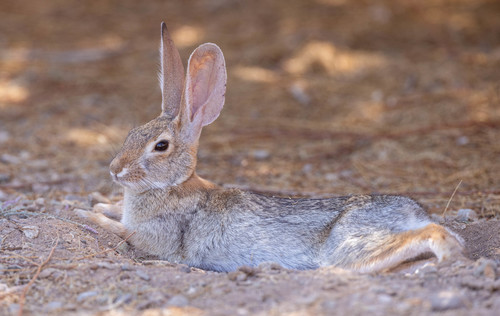
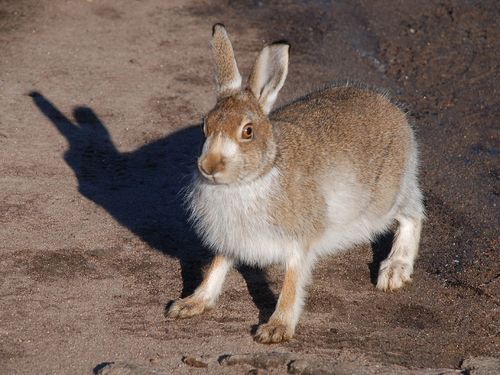
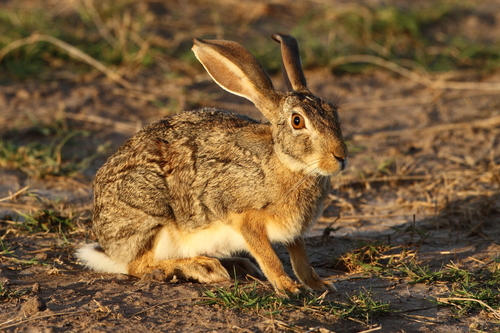
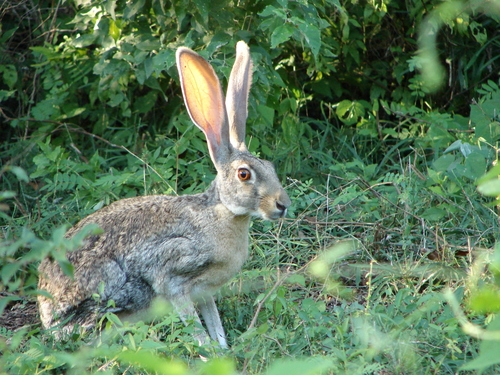
The antelope jackrabbit, scientifically named Lepus alleni Mearns, 1890, is a large hare that has long been considered the handsomest species in its genus. Males and females of this species have identical appearance. This large species has long, pointed ears and distinct coat coloration: it has a white belly, light grey sides, a back speckled with black, and orange coloring on the neck and chest. It is similar in appearance to other hare species including the black-tailed jackrabbit and the white-sided jackrabbit. Its total body length ranges from 52 to 58 centimeters (20 to 23 inches), and its tail measures 5 to 10 cm (2 to 4 in) long. Its front legs reach 10 to 20 cm (4 to 8 in) in length, while its back legs grow to 20 to 30 cm (8 to 12 in) long. Its ears measure 14–17 cm (6–7 in), and the species can weigh up to 9 pounds (4.1 kg). Antelope jackrabbits have a very large skull and a long rostrum. Their extremely long ears have white coloring on the tips and edges. Their two-colored tail is black on the upper side and pale grey on the underside. The species' physiology, including the shape of its skull, supports its fast hopping movement, with an estimated top speed of 72 kilometers per hour (45 mph). The European hare (L. europaeus) is reported to reach a similar top speed. In terms of distribution and habitat, the antelope jackrabbit occurs in parts of Arizona in the United States, and in the Mexican states of Chihuahua, Nayarit, Sinaloa and Sonora in northwestern Mexico. It also lives on Tiburón Island, Mexico's largest island, located in the Gulf of California. Compared to other North American hare species, the antelope jackrabbit has a limited range. It does not live further east than Arizona's sky islands and Mexico's Sierra Madre Occidental, and it does not occur west of Florence, Arizona. As of July 2017, it had been spotted and photographed by a National Park Ranger in Nevada's Lake Mead National Recreation Area. The antelope jackrabbit inhabits a variety of tropical and subtropical habitats. It can be found on grassy hills or plains, and prefers habitats with large desert shrubs growing above tall grass. It also occurs in more barren desert habitats. A 2014 ecological study found that ideal habitat for the antelope jackrabbit includes grassy ground cover and a mesquite overstory. This species does not favor arid climates; instead, it lives in areas with summer precipitation between 90 mm and 360 mm. Unlike the black-tailed jackrabbit, which survives in drier conditions, the antelope jackrabbit occupies areas with higher humidity. Antelope jackrabbits are most active during twilight (they are crepuscular) and at night (they are nocturnal), but may be active during the day when conditions are favorable, such as when there is heavy cloud cover. For reproduction, antelope jackrabbits breed from December to September, with a gestation period of approximately six weeks. Females can have up to four litters per year, with each litter holding between one and five young. Baby antelope jackrabbits are called leverets, and they are born precocial: they have open eyes, are active from birth, and are fully covered in fur. Young are born in shallow dirt nests formed by scraping the ground's surface. Leverets reach sexual maturity at roughly 6 months of age.