About Lepuropetalon spathulatum (Muhl.) Elliott
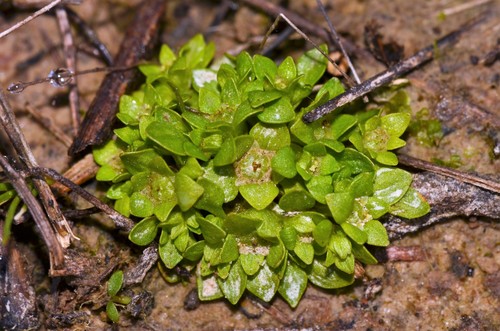
Lepuropetalon spathulatum is a very small winter annual. In growing conditions that are favorable, it forms a hemispherical tuft, reaching up to 2 centimeters in both height and width, and rarely grows larger. Many individuals consist of no more than a single flower positioned above a few tiny leaves, with the entire plant measuring less than 5 millimeters in height and 5 millimeters across. Its stems, leaves, and flowers are noticeably dotted with epidermal sacs that contain tannin, and these sacs are often arranged in lines. The sacs are golden-brown or slightly reddish in color. The stems of this species are rather thick and slightly angled. Its leaves are arranged alternately or suboppositely, are sessile, and are longer than they are wide, widening toward the tip in a shape like a spoon or spatula. Flowers are solitary, growing at the ends of stems immediately above the leaves, and they usually face upward. The flowers are large relative to the size of the rest of the plant, measuring 2 to 3 millimeters in diameter, with both fully functional male and female reproductive parts. The calyx is made up of five broad, often unequal sepals that are joined at their lower portion to form a floral cup. This cup encloses the lower half of the ovary, and is thickened along its fissures to form five ribs. The sepals remain on the plant even after the fruit matures. The petals are scale-like, white, barely visible, and grow on the rim of the floral cup between the sepals; they are sometimes absent entirely. The petals wither but remain attached to the plant, along with the sepals. The five stamens are short and positioned opposite the sepals. When they first develop, they curve inward and shed their pollen directly onto the ovary. As the ovary expands, it eventually bends the stamens outward. The anthers are yellow, erect, and roughly spherical in shape. Five staminodes are positioned opposite the petals and are widened at their ends. The gynoecium is single-chambered and formed from three fused carpels. Numerous ovules are produced, and attach near the margins of the carpels. The three stigmas are either separate, or initially joined at the base before separating as the ovary grows. The stigmas are commissural, meaning the pollen-receptive area extends downward along the fissures where the carpels are joined. The fruit produced is a capsule, which holds numerous cylindrical seeds. Seeds measure 0.15 to 0.2 millimeters long, are reddish when immature, and turn nearly black when fully ripe.