About Leptotila rufaxilla (Richard & Bernard, 1792)
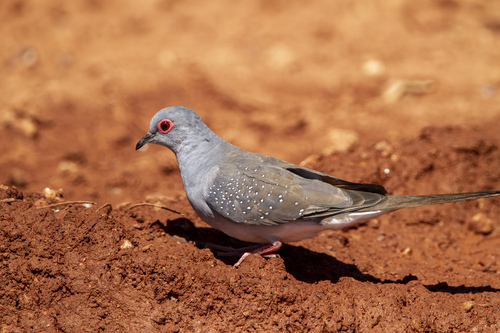
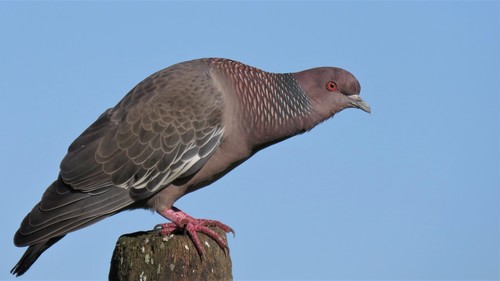
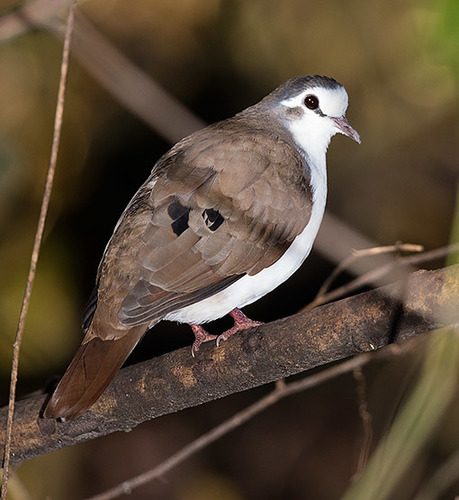
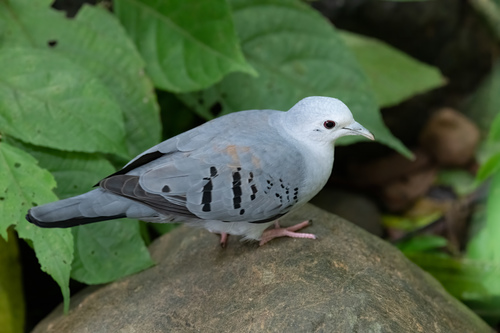
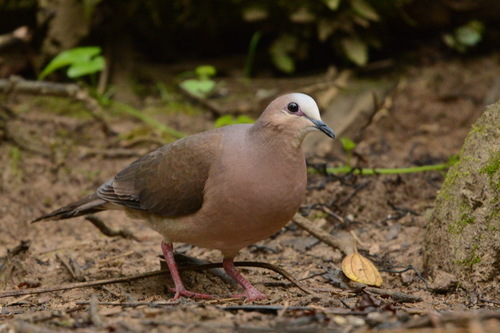
The grey-fronted dove (Leptotila rufaxilla) is approximately 28 cm (11 in) long and weighs between 115 and 183 g (4.1 to 6.5 oz). Adult males of the nominate subspecies have a grayish to bluish forehead (the 'front' that gives the species its name), a bluish gray crown, and a grayish purple nape and hindneck with some iridescence. A ring of bare red skin surrounds the yellow or brown eye, and this ring is itself surrounded by pinkish white feathers. The throat is also pinkish white, and the rest of the face ranges from buff to pinkish buff. The bird's upperparts are olive-brown, with faint bronze or purplish tones on the mantle. Its central tail feathers are also olive-brown, while the outer tail feathers are blackish with distinct white tips. The breast and sides of the neck are greyish pink, which shades to white on the belly. The bill is black, and the legs and feet are red. Adult nominate females are browner than males, with an olive cast to the flanks and green-tinged upperparts. Juveniles are similar in appearance to females, but their breasts have rust and drab brown bars, and the feathers of their upperparts have rusty edges. Other subspecies differ slightly in size, and their coloration can be redder, pinker, or grayer than that of the nominate subspecies. The grey-fronted dove is a resident breeder in South America. It occurs on Trinidad and east of the Andes, ranging from Colombia, Venezuela, and the Guianas south to Paraguay, Uruguay, and northeastern Argentina. The subspecies have the following ranges: L. r. pallidipectus is found in eastern Colombia and probably western Venezuela; L. r. dubusi occurs from southeastern Colombia to south-central Venezuela, extending south through eastern Ecuador to eastern Peru and east into western Brazil; L. r. rufaxilla is found in eastern Venezuela, the Guianas, and northern Brazil; L. r. helmayri occurs on Venezuela's Paria Peninsula and on Trinidad; L. r. bahiae is found in central Brazil; L. r. reichenbachii occurs in central and southern Brazil, extending south to northeastern Argentina, Paraguay, and Uruguay. This dove inhabits humid forest, most commonly in the forest interior, but also occurs at forest edges and in clearings. In Colombia, it has been recorded in várzea, terra firme, and gallery forests. In terms of elevation, it is found below 550 m (1,800 ft) in Venezuela, and occurs locally as high as 2,200 m (7,220 ft) in southeastern Brazil.