About Leptotila plumbeiceps P.L.Sclater & Salvin, 1868
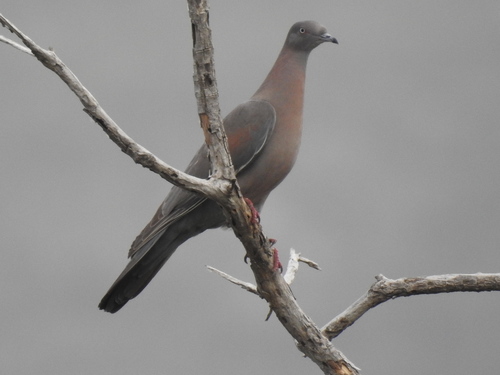
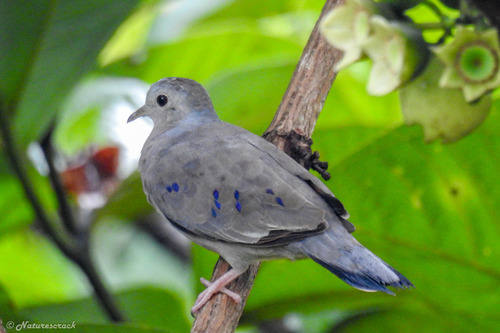
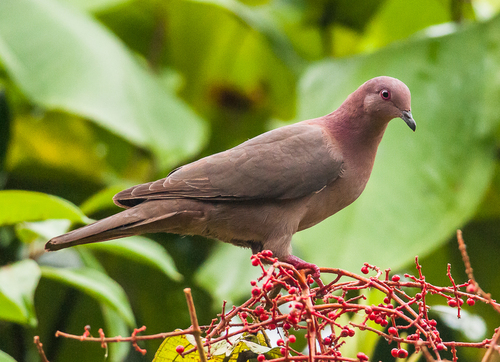
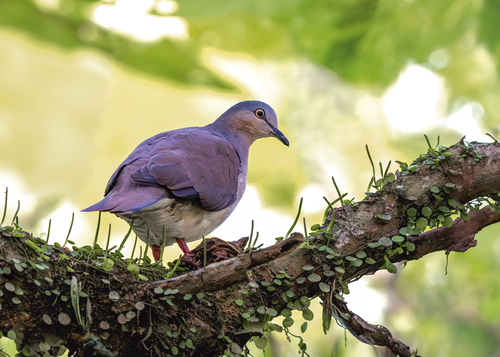
Leptotila plumbeiceps (grey-headed dove) was first described by P.L. Sclater & Salvin in 1868. This species measures 23.5 to 26 cm (9.3 to 10.2 in) in length and weighs 139 to 205 g (4.9 to 7.2 oz). For the nominate subspecies, the adult male has a pale bluish gray forehead, with a slightly darker gray on its crown, nape, upper mantle, and the sides of the neck. The rest of its face is pinkish buff, with white throat and belly, and pale pink breast. Its upperparts are olive brown with a rufous wash. The central tail feathers are dark olive brown, while the outer three are black with white tips. Its bill is black, and its legs and feet are pink. The adult female is very similar to the male, but has an additional grayish fawn wash on the breast. Juveniles have a more intense olive coloration on their upperparts than adults, and their breast has a barred pattern. The subspecies L. p. notia has darker overall coloration than the nominate subspecies, with more olive-toned upperparts. The nominate subspecies is distributed from eastern Mexico south to northern Nicaragua, with a disjunct range in southern Nicaragua, northwestern Costa Rica, and the western Andes of Colombia. L. p. notia occurs on the Caribbean slope of western Panama. The grey-headed dove lives in the interior and edges of both primary and secondary humid forest. In Colombia, it appears to prefer dryer types of forest. Across most of Central America, it occurs at elevations from sea level up to 900 m (3,000 ft), and it can reach 1,500 m (4,900 ft) in Honduras. In Colombia, it is mostly found between 1,000 and 1,800 m (3,300 and 5,900 ft), and can be found up to 2,600 m (8,500 ft) on Puracé, an active volcano.