About Leptotila jamaicensis (Linnaeus, 1766)
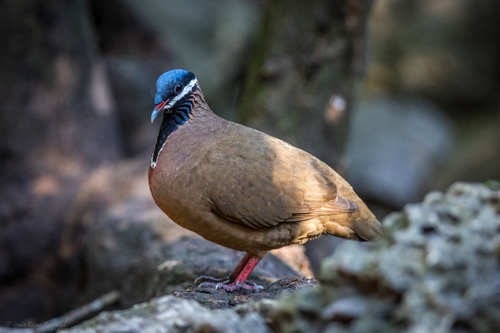
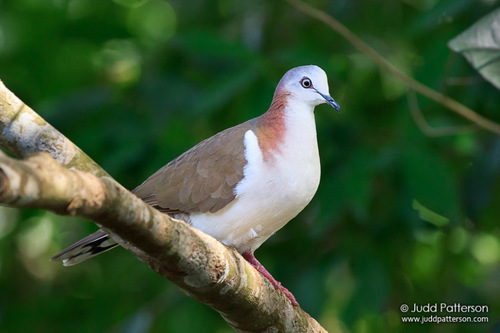
Leptotila jamaicensis, commonly called the Caribbean dove, measures 29 to 33 cm (11 to 13 in) in length and weighs 117 to 190 g (4.1 to 6.7 oz). For the nominate subspecies, the adult male has a white forehead, face, and throat, a gray hindcrown, and an iridescent purple nape. Its mantle and the sides of the neck are rosy red with an iridescent green and/or purple gloss, and all of its underparts are white. Its upperparts are olive-brown, with a visible white band on the front of the folded wing. The inner feathers of the tail are grayish brown, while the outer tail feathers are black with white tips. Its eye is white or white with a red ring, surrounded by bare dull purple skin, and its legs and feet are red. The female is similar to the male but has duller iridescence. Juveniles resemble adults but are duller overall, and many of their feathers have reddish edges. Four subspecies are recognized, each with distinct traits: L. j. collaris is similar to the nominate subspecies but is smaller on average. L. j. gaumeri is slightly smaller than the nominate, with a darker olive cast on its upperparts, a reddish cast on its breast, and less bright iridescence. L. j. neoxena is intermediate in size and color between the nominate subspecies and L. j. gaumeri. The subspecies of the Caribbean dove have separate ranges: L. j. collaris is found on the Cayman Islands. L. j. gaumeri occurs in Mexico's northern Yucatán Peninsula, Isla Mujeres, Isla Holbox, and Cozumel; Belize's Ambergris Caye; and the Honduran islands of Barbareta, Roatán, and Little Hog. L. j. jamaicensis (the nominate subspecies) is native to Jamaica and was introduced to New Providence in the Bahamas. L. j. neoxena is found on Colombia's San Andrés island, located off eastern Nicaragua. Across most of its range, the Caribbean dove lives in semi-arid lowlands, and prefers areas that have at least some shrub or tree cover. On Jamaica, it inhabits dry limestone forest, especially secondary forest in the foothills, and can be found as high as 2,000 m (6,600 ft) in the Blue Mountains.