About Leptotes pirithous (Linnaeus, 1767)
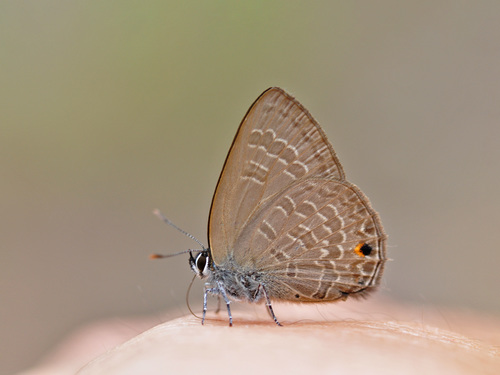
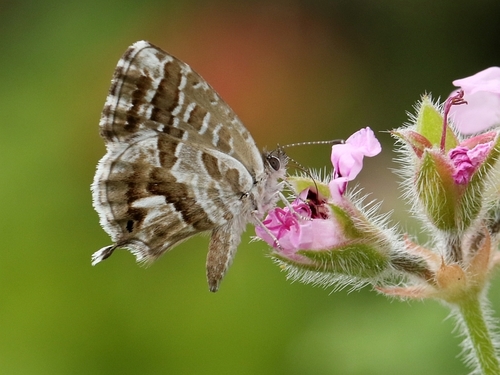
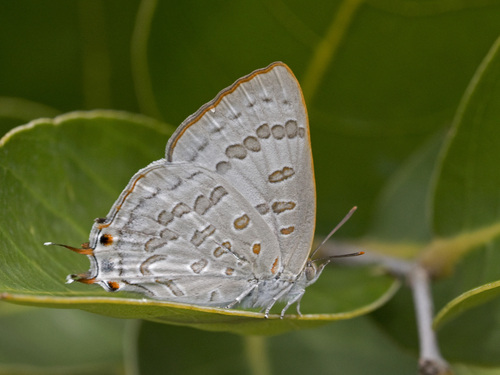
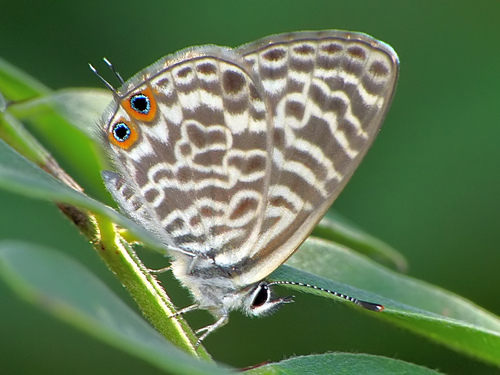
Leptotes pirithous (Linnaeus, 1767) is a small butterfly. Males have a wingspan of 21–29 mm (0.83–1.14 in), while females have a wingspan of 24–30 mm (0.94–1.18 in). The upperside of the wings is purple bluish in males and bluish brown in females. The undersides of the wings are dark beige, striped with white lines. The hindwings have marginal orange and black spots plus two small tails. Due to the pattern of their wing undersides, this species can be confused with Lampides boeticus and Cacyreus marshalli. In Seitz's description, this species is referred to as T. telicanus Lang (? = pirithous L., baeticus Esp.) (77 h; the figure marked as male actually represents a small female). In this description, males are violet-blue, while females are smoky grey with a bluish white disc on the forewing; the intricate underside markings also appear on the wing uppersides. The underside has a smoky grey base with a complex arrangement of white lines and rings, and very thin, intensely glittering blue rings around the anal spots of the hindwing. This form is found in South Europe, North Africa, and Asia Minor. The form bellieri Ragusa from Sicily has a more unicolorous, washed-out underside. The larva is dark red, with a black-known dorsal line and dark oblique stripes. It develops in June and autumn on Melilotus and Medicago, and is also reported to occur on Calluna vulgaris. The pupa is yellowish brown with dark markings. Adult butterflies appear in early spring and again in late summer, occur singly and are usually not abundant. They prefer to rest on clusters of Thymus, fly rather fast, and appear to migrate in certain years. As rare exceptions, individuals have been observed far to the north in localities such as Bale, Stuttgart, Augsburg, and Bozen. This species can be found in southern Europe (including Spain, France, and Italy) along the Mediterranean coast, from Asia Minor up to the Himalayas, and across most of Africa and Madagascar. It prefers varied natural habitats, cultivated areas, and gardens.