About Leptospermum continentale J.Thomps.
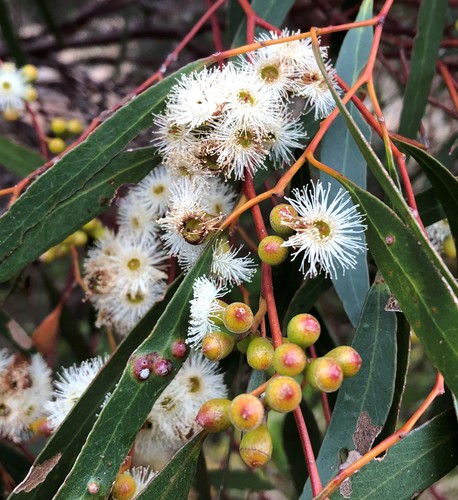
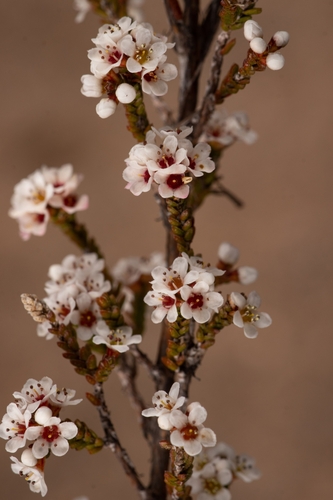
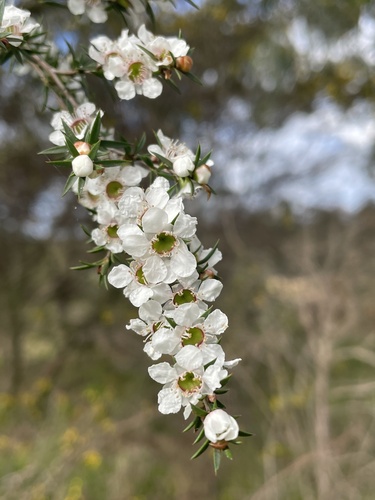
Leptospermum continentale, commonly known as prickly tea-tree, is a slender, straggling shrub that typically grows 1 to 2 meters (3 feet 3 inches to 6 feet 7 inches) tall, and sometimes grows taller. This species has smooth bark that is shed in stringy strips. Its leaves are narrow egg-shaped, 5 to 13 millimeters long and 1 to 3.5 millimeters wide, with a sharp point at the tip. The flowers grow singly in leaf axils; each flower is 8 to 12 millimeters in diameter, on a pedicel up to 1 millimeter long, and has a floral cup 2 to 3 millimeters long. The sepals are triangular, mostly hairless, around 1.5 millimeters long, and fall off as the flower opens. Petals are most often white, and rarely pink, measuring 3 to 5 millimeters long, while the stamens are 1.5 to 2 millimeters long. Flowering takes place between September and February. After flowering, the plant produces a broadly hemispherical capsule fruit 5 to 8 millimeters wide, which stays attached to the plant when it matures.
Prickly tea-tree is distributed from Mudgee in central eastern New South Wales and the Australian Capital Territory, south to the southern half of Victoria and south-eastern South Australia. It grows widely in heath and woodland on well-drained sandy soil, and also grows in swampy areas. In horticulture, this tea-tree can be propagated from either cuttings or seed. It is a hardy shrub that tolerates most soil types and growing conditions, including poorly-drained sites.