About Leptosomus discolor (Hermann, 1783)
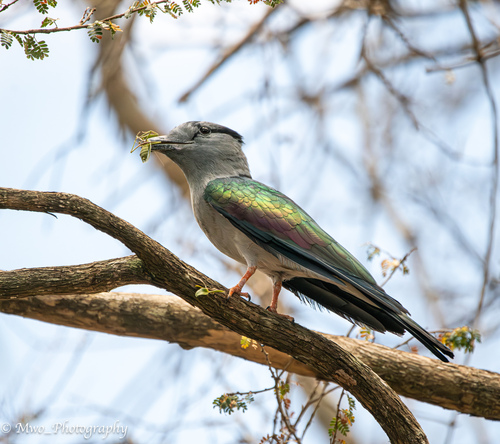
This species, the cuckoo-roller, is scientifically named Leptosomus discolor (Hermann, 1783). The cuckoo-roller has a total length of 40–50 cm (16–20 in). Among its subspecies, the nominate subspecies is the largest, while L. d. gracilis is the smallest. Unlike true rollers and ground rollers, which have identically appearing sexes, the cuckoo-roller is sexually dichromatic. Males have mostly velvety grey chests and heads, that gradually change to white on the remaining underparts; the demarcation between grey and white is stronger in L. d. gracilis. Their back, tail, and wing-coverts are dark iridescent green with a purplish tinge, especially on the wing-coverts, and their crown and eye-stripe are black. Females are mostly brown, with strongly dark-spotted pale underparts, with less spotting seen in L. d. gracilis. Juveniles are generally reported to resemble a dull female, but at least L. d. gracilis juveniles are sexually dimorphic, and this may also apply to the other subspecies. The cuckoo-roller has a stout bill, and its eyes are set far back on the face. Its legs and feet are small, and the feet have an unusual structure that confused many ornithologists, though it is now thought to be zygodactylous, meaning two toes face forwards and two face backwards. The cuckoo-roller occupies a wide variety of habitats, including altered areas. It inhabits multiple types of forest: rainforest, litoral forest, deciduous forest, spiny bush-forest, and also occurs in tree plantations. In the Comoros, the species is found on all major islands, particularly in forested zones. Its elevation range extends from near sea level up to 2000 m. The diet of the cuckoo-roller is not well known, but a 1931 expedition found chameleons and insects, particularly locusts and caterpillars, are important food items. Stomachs of cuckoo-rollers have often been found lined with caterpillar hairs. Other prey the species takes includes grasshoppers, cicadas, stick insects, and geckos. The cuckoo-roller’s main foraging technique is to perch motionless while watching for prey, then make a quick sally towards the prey once it is spotted. The species also hunts from the air. Prey is caught in the large bill and killed by beating it against a branch. Very few studies have examined the breeding habits of the cuckoo-roller. In the past it was described as a polygamous breeder, but no evidence supports this claim. Nests are located in natural cavities in tall trees, 4–6 m (13–20 ft) off the ground. No lining is added inside the cavity, and white eggs are laid directly on the cavity bottom. The usual clutch size is around four eggs. Only the female performs incubation, while the male feeds her. The incubation period is about 20 days, after which fluffy chicks hatch. Chicks stay in the nest for 30 days before fledging.

