About Leptosia nina (Fabricius, 1793)
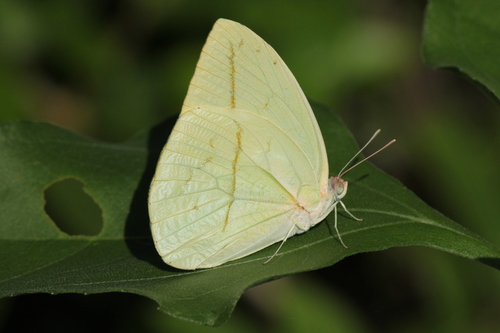
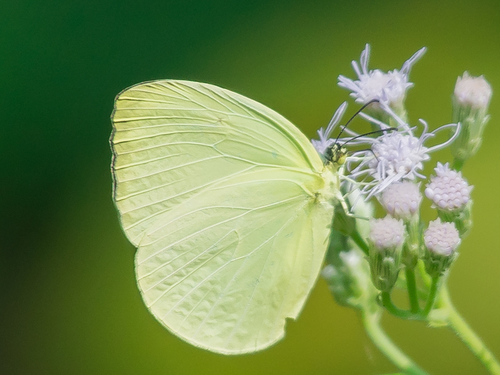
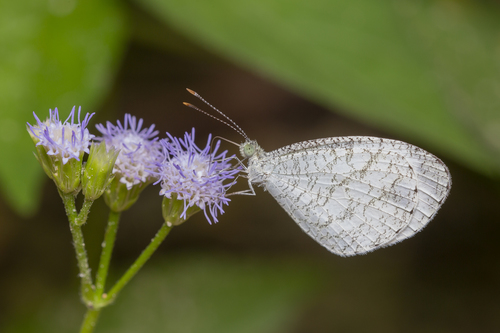
This description of Leptosia nina (Fabricius, 1793), which carries the common name "wandering snowflake" from Lionel de Nicéville's unpublished manuscript, is taken from Charles Thomas Bingham's 1907 work The Fauna of British India, Including Ceylon and Burma. Butterflies. Vol 2. For the upperside of the wings: the base color is white, with only very slight dusting of minute black scales at the wing bases. On the forewing, the costa is faintly and obscurely speckled with black; the apex is black, with an inwardly angled inner margin to this black area; there is also a very large, somewhat pear-shaped post-discal black spot. The hindwing is uniformly white; most specimens have an obscure, extremely slender black terminal line. On the underside, the base color is white. The costal margin and apex of the forewing are broadly speckled, and the entire surface of the hindwing is also speckled, with transverse, very slender greenish strigae and minute dots; on the hindwing, these markings tend to form obscure, obliquely transverse sub-basal, medial, and discal bands. The postdiscal black spot on the forewing matches that seen on the upperside. The terminal margins of both the forewings and hindwings have small, short, black transverse slender lines at the vein apices, and these lines often coalesce to form a continuous terminal line matching that on the upperside. Antennae are dark brown spotted with white; the head is slightly brownish; the thorax and abdomen are white. Females are similar to males, with overall slightly broader black markings on the upperside of the forewing, though this is not a consistent trait. Wingspan ranges from 25 to 53 mm. Its habitat range covers the lower ranges of the Himalayas from Mussoorie to Sikkim; Central, Western, and Southern India (excluding desert tracts); Sri Lanka; Assam; Burma and Tenasserim; and it extends further to China and the Malayan region. The larva is green with a pale glaucous tint near the leg bases, and is slightly hairy. It feeds on capers; Capparis zeylanica is a recorded food plant, and larvae also feed on the leaves of Cardamine and Cleome species. The pupa is sometimes green, but more often takes on a delicate pink shade. Both the larva and pupa closely resemble those of Terias hecabe, but are more delicately formed, as noted by Davidson, Bell and Aitken and quoted in Bingham's work.