About Leptoscarus vaigiensis (Quoy & Gaimard, 1824)
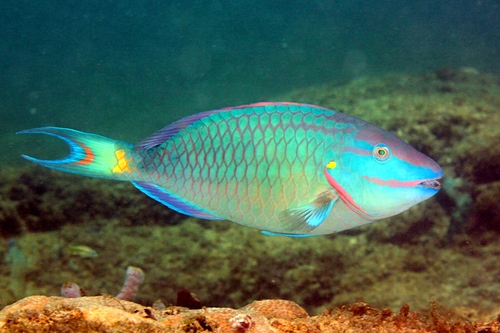
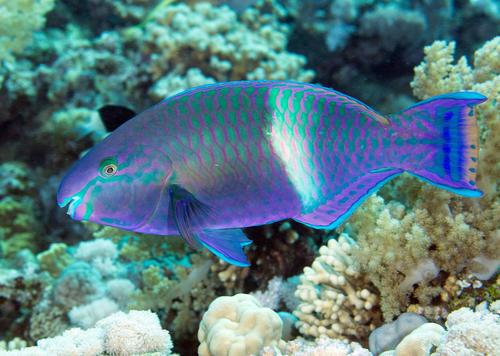
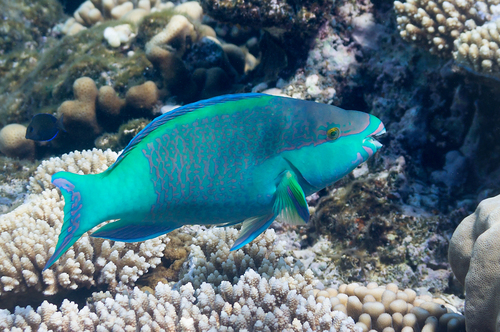
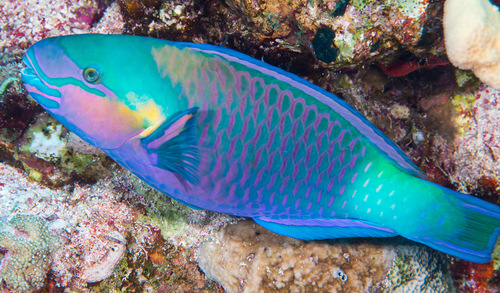
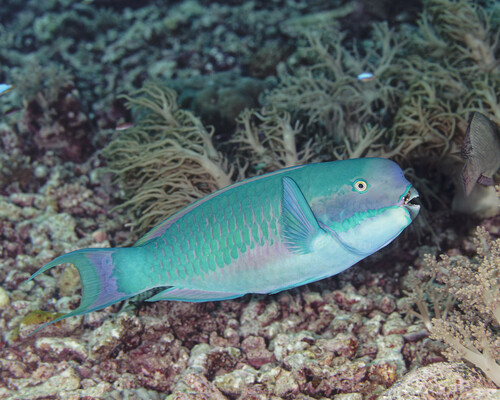
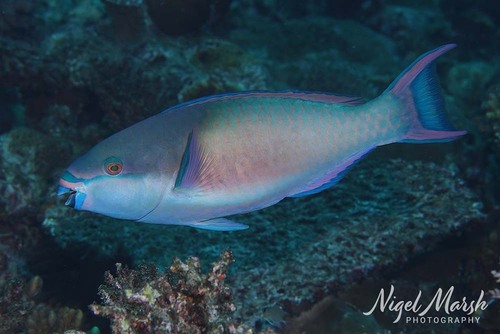
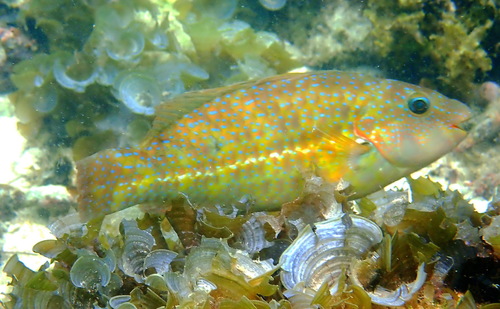
Leptoscarus vaigiensis, commonly called the marbled parrotfish, has a base body color ranging from brown to green, with darker mottled patterning on the back that fades to yellow or greenish on the ventral side. Males have a pale longitudinal stripe along their flanks, and small blue spots across the head, body, dorsal fin and anal fin. Females have a mottled pattern of brown and white, with broad bands that radiate out from the eyes on their heads. This species has 9 spines and 10 soft rays in its dorsal fin; its anal fin has 3 spines and 9 soft rays, and its pectoral fin has 13 rays. It has distinctive narrow dental plates fused into a parrot-like beak, covered with many small teeth. When its mouth is closed, the teeth of the upper jaw are completely enclosed by the lower jaw. The maximum total length this species can reach is 35 centimetres, or 14 inches. The marbled parrotfish has a wide distribution across the Indo-Pacific region. Its range stretches from the northern Red Sea, south along the eastern African coast to the Cape of Good Hope, and east through the Indian and Pacific Oceans all the way to Easter Island. In the Pacific Ocean, its range extends north to Japan and south to Rottnest Island off Western Australia and the Poor Knights Islands of New Zealand. In the southeastern Atlantic, this species is found in False Bay, Western Cape, South Africa. Its distribution is largely anti-equatorial: it occurs in both the Northern and Southern Hemispheres, but is rare or absent near the Equator. The marbled parrotfish inhabits sheltered bays, harbours and lagoons, found among seagrass beds and algal-covered reefs. It typically lives in small groups, and occurs at depths ranging from 0 to 15 metres, or 0 to 49 feet. Uniquely among parrotfish, this species is gonochoristic, meaning females never change sex to become males. Spawning takes place in shallow water over flat seagrass beds during the ebbing tide. In addition to being gonochoristic, marbled parrotfish also show less sexual dimorphism than most other parrotfish species. Their diet is made up of seagrass and algae. The larvae of the marbled parrotfish are associated with drifting algae.