About Leptopyrum fumarioides (L.) Rchb.
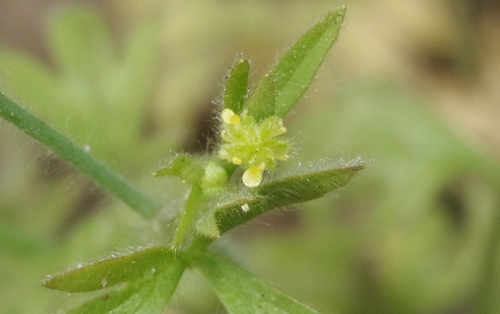
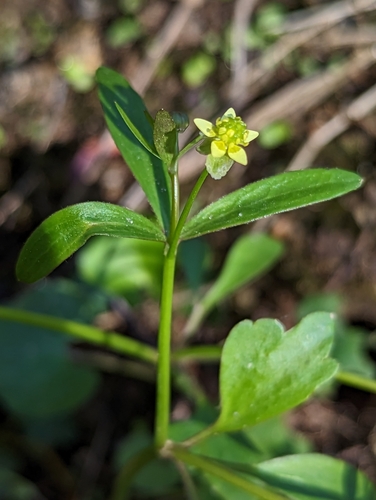
Leptopyrum fumarioides (L.) Rchb. is an annual herb. Morphologically, it reaches 8–30 cm (3–12 in) in height, and produces 4 to 9 smooth, sparsely branched stems; rarely, stem counts can be as low as 2 or as high as 17. Its leaves are triangular-ovate, borne on stalks 2.5–13 cm (1–5 in) long. Leaflets are rhombic in shape; the central leaflet has a short stalk, and each leaflet is divided into three unequal, narrow, teardrop-shaped lobes. Leaflet margins can be either smooth or bear small teeth. Flowers are 3–5 mm in diameter, with oval yellowish sepals 3–4.5 mm long, and smooth petals 1 mm long. Stamens measure approximately 3 mm in length, while anthers measure approximately 0.5 mm.
This species is native to Russia (specifically Siberia, Amur Oblast, and Khabarovsk Krai), Kazakhstan, China (specifically Gansu, Hebei, Heilongjiang, Jilin, Liaoning, Inner Mongolia, Qinghai, Shaanxi, Shanxi, and Xinjiang), Korea, and Mongolia. It grows at altitudes between 100 and 1,400 m (330 to 4,590 ft), in habitats including forest margins, grassy areas, and alongside fields.
Ecologically, Leptopyrum fumarioides flowers from May to July, and produces fruit from June to July. In Mongolian and Tibetan traditional medicine, the plant has been used to treat fever, typhoid fever, elevated blood pressure, liver diseases, cardiovascular diseases, gastrointestinal diseases, and edema, as well as to treat various types of intoxication. Chemical compounds found in the plant have been shown to protect DNA from damage caused by catechol, likely through acting as potent antioxidants.