About Leptoptilos javanicus (Horsfield, 1821)
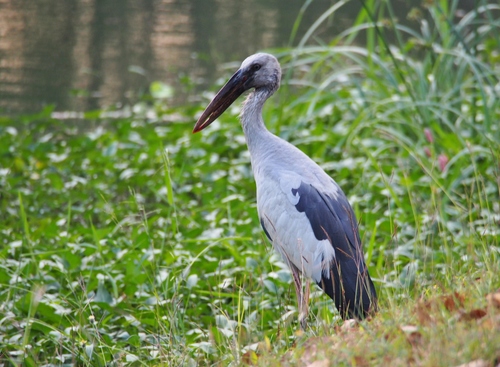
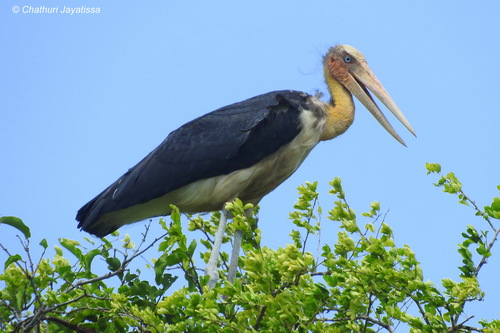
Leptoptilos javanicus, commonly known as the lesser adjutant, is a large stork with an upright stance, a bare head and neck, and no pendant pouch. It measures 87–93 cm (34–37 in) from bill to tail, weighs 4 to 5.71 kg (8.8 to 12.6 lb), and stands approximately 110–120 cm (43–47 in) tall. The only species it can be confused with is the greater adjutant, but the lesser adjutant is generally smaller, has a straight upper bill edge (culmen) 25.8–30.8 cm (10.2–12.1 in) long with a paler base, and has a slightly trimmer build with less of a hunch-backed posture. Its skullcap is paler, and its upper plumage is uniformly dark, appearing almost entirely black. The nearly hairless head and neck have only a few scattered hair-like feathers. The upper shank (tibia) is grey rather than pink, and the tarsus measures 22.5–26.8 cm (8.9–10.6 in). The belly and undertail are white. Juveniles are a duller version of adults, but have more feathers on the nape. During the breeding season, the face turns reddish and the neck turns orange. The larger median wing coverts are tipped with copper spots, and the inner secondary coverts and tertials have narrow white edging. The wing chord measures 57.5–66 cm (22.6–26.0 in) in length. Like other species in the genus Leptoptilos, lesser adjutants retract their necks during flight; the folded neck can sometimes look like the pouch of a greater adjutant. Males and females have similar plumage, but males tend to be larger with heavier bills.
The lesser adjutant is most often found in large rivers and lakes within well-wooded regions, freshwater wetlands in agricultural areas, and coastal wetlands including mudflats and mangroves. It occurs in India, Nepal, Sri Lanka, Bangladesh, Myanmar, Thailand, Vietnam, Malaysia, Laos, Singapore, Indonesia, and Cambodia. In 2011, a colony of about 6 nests and 20 individuals was discovered near Thakurgaon, Bangladesh. The largest population of the species is located in Cambodia. In India, it is mainly distributed in the eastern states of Assam, West Bengal, and Bihar. It may occur as a vagrant on the southern edge of Bhutan, and is extremely rare in southern India. In Sri Lanka, it is found in lowland areas mostly within protected areas, though it also uses forested wetlands and crop fields. Early surveys in eastern Nepal suggested the species preferentially used forested patches with small wetlands and largely avoided crop fields. However, additional research shows the opposite: breeding densities and breeding success of the lesser adjutant across lowland Nepal are much higher on croplands.
The lesser adjutant stalks through wetlands, feeding mainly on fish, frogs, reptiles, large invertebrates, rodents, and small mammals, and only rarely eats carrion. It appears to locate prey entirely by sight; one study recorded storks perching on telegraph poles scanning marshes for prey. They are largely silent, but have been observed clattering their bills, hissing, and moaning at the nest. During a threat display called the "Arching display" performed when intruders are present, adults extend their neck and sometimes give a hoarse wail. Courtship behaviour of the lesser adjutant is identical to that of other species in the genus Leptoptilos. During pair formation, female birds lift their heads in a scooping motion accompanied by bill-clattering, a behaviour called the "Balancing Posture". They are solitary except during the breeding season, when they form loose colonies that never exceed 20 nests in a single colony. The breeding season runs from February to May in southern India, and from November to January in north-eastern India, and can begin as early as July. In central lowland Nepal, nesting in 2015 began in July, with new colonies continuing to be initiated through November.
The nest is a large platform made of sticks, built on a tall tree. In Nepal, nest initiations started in mid-September and continued until mid-November, with all chicks fledging by late January. The nest has a diameter of more than one metre and can be up to one metre deep. The clutch consists of two to four white eggs that become soiled quickly during incubation. The incubation period lasts 28–30 days. In eastern Nepal, all four observed colonies (totalling 61 nests) were built on the tree species Haldina cordifolia and Bombax ceiba. In central lowland Nepal, 35 colonies with 101 nests were located on four tree species: Haldina cordifolia, Bombax ceiba, Ficus benghalensis, and Ficus religiosa, with the majority of colonies located on Bombax ceiba trees. A subsequent study across five locations in lowland Nepal monitored 65 colonies with 206 nests, from which 280 chicks fledged; the most frequently used tree species were B. ceiba, H. cordifolia, and F. religiosa, in that order. In India and Myanmar, nests have also been found on Alstonia scholaris and Salmalia malabarica, with some nests located as high as 46 m. Nests have not yet been recorded in Sri Lanka, though young birds have been observed feeding in crop fields and freshwater wetlands there. The average size of 35 colonies (totalling 101 nests) in central lowland Nepal was 2.9 nests, ranging from 1 to 13 nests per colony. Colony location in central lowland Nepal was not related to landscape-level tree density, suggesting that enough nest trees are still available in this area. However, lesser adjutant storks almost entirely selected non-domestic trees for nesting, and strongly preferred trees that were much taller and larger than other available trees on the landscape. Religious beliefs and agro-forestry practices appear to be responsible for retaining these preferred trees for lesser adjutant colonies.
Breeding success in lowland Nepal is positively correlated with colony size, possibly because larger colonies have lower predation rates. Colony-level breeding success is also affected by the amount of wetland area around colonies, which reduces the negative impacts of proximity to human settlements. Colonies located on trees in agricultural landscapes of lowland Nepal had higher breeding success than colonies located on trees in forested areas or protected wetland reserves. This suggests that current agricultural practices, with one season of flooded rice during the monsoon followed by winter crops that require pulsed irrigation such as wheat, support lesser adjutant breeding well. Multi-site studies show that lesser adjutants use cues like tree height to select colony locations; taller trees host larger colonies, which in turn have higher fledging success.
Adult storks took an average of 30 minutes to return to nests with food for nestlings and fledglings, though this time varied considerably. How long adults took to return to the nest was affected by colony size, chick age, the amount of wetland around the colony, and the progression of the breeding season. Adults returned faster when they had larger broods, but took longer to return as chicks aged. The breeding season in Nepal extends from the middle of the monsoon, when the main landscape crop is flooded rice, to winter, when cropping is much more mixed and the landscape is much drier. This seasonal variation is clearly reflected in the changing time adults take to return to the nest after finding food. They returned much faster during the monsoon, but took longer as crops changed and the landscape dried out, which suggests that changing cropping patterns can have significant impacts on their ability to raise chicks. A lesser adjutant has been recorded pairing and hybridizing with a painted stork at Dehiwala Zoo in Sri Lanka and at Kuala Lumpur Zoo. The hybrid offspring had the plumage and bill size of the adjutant, but the stance and bill shape of the painted stork.